How Big of a Solar Battery Do I Need to Power My House in 2026?
Rising energy costs and the increasing frequency of grid blackouts have fundamentally shifted how property owners view energy infrastructure. A decade ago, grid-tied photovoltaic panels were sufficient for offsetting utility bills. Today, genuine energy security requires localized storage. The most critical question homeowners bring to our engineering teams is: exactly what size solar battery do I need to power my house effectively and reliably?
A residential energy storage system captures the surplus electricity generated during peak sunlight hours and holds it for consumption during the evening or utility failures. As a quick answer summary, a typical residential installation requires a storage capacity ranging from 10 kWh to 30 kWh, depending heavily on your consumption profile and backup goals. However, properly calculating what solar battery do I need to power my house requires a precise technical audit rather than a simple guess.
In this authoritative guide, we will break down the thermodynamics of residential energy storage. You will learn how to read your electrical load profiles, understand the difference between peak power and storage capacity, navigate the costs in 2026, and definitively answer the question of what size solar battery do I need to power my house.
Table of Contents
- Summary Table: Storage Capacity Baselines
- What Is a Solar Battery and How Does It Work?
- Key Factors That Determine Battery Size
- How to Calculate the Right Solar Battery Size
- Typical Solar Battery Sizes for Homes
- Popular Solar Batteries and Their Capacities
- How Many Batteries Do You Need?
- Cost of Solar Batteries in 2026
- Whole-Home Backup vs Essential Loads Only
- Off-Grid vs Grid-Tied Battery Sizing
- Common Mistakes When Choosing Battery Size
- Pro Tips for Choosing the Right Battery
- Frequently Asked Questions (FAQs)
- Conclusion
Summary Table: Storage Capacity Baselines
To assist in your initial assessment of what size solar battery do I need to power my house, we have provided a baseline matrix correlating daily usage with recommended storage capacities.
| Home Profile / Usage | Average Daily Load | Recommended Storage Capacity | Typical Backup Capability |
|---|---|---|---|
| Small Home / Energy Efficient | 10 – 15 kWh | 5 – 10 kWh | Essential loads only (fridge, router, lights) overnight |
| Medium Home / Standard Usage | 20 – 30 kWh | 10 – 20 kWh | Partial home backup, sustaining essential appliances for 24 hours |
| Large Home / Heavy Electrical Load | 40+ kWh | 20 – 30+ kWh | Whole-house backup, including HVAC and water heating |
What Is a Solar Battery and How Does It Work?
When clients ask what size solar battery do I need to power my house, we first explain the basic architecture of a Battery Energy Storage System (BESS). A solar battery utilizes chemical storage—predominantly Lithium Iron Phosphate (LiFePO4) in 2026—to store excess direct current (DC) electricity generated by your rooftop panels.
The key components of this architecture include the photovoltaic array, the battery bank itself, and the Solar Inverter. The inverter is critical because it converts the stored DC power into alternating current (AC) power, which is the standard format required by your household appliances.
Systems can be AC-coupled or DC-coupled. DC-coupled systems store the energy directly from the panels before inversion, offering higher efficiency. AC-coupled systems convert the panel energy to AC for home use, then invert the excess back to DC for battery storage, which is often easier for retrofitting existing arrays. The daily energy cycle involves charging the bank during peak irradiation, storing the thermal energy, and discharging it precisely when grid power drops or utility rates peak.
Key Factors That Determine Battery Size
From our experience at MoneyPro Energy, determining what size solar battery do I need to power my house requires a detailed audit of five primary variables.
1. Your Daily Energy Consumption (kWh)
The absolute foundation of your calculation is your current electricity consumption. You must learn how to read your electricity bills properly. Look at your 12-month average, not just a low-usage month. The average U.S. home consumes between 20 and 30 kWh per day. If you run multiple air conditioning zones, this number will escalate.
2. Backup Duration Needed
Are you trying to survive a three-hour rolling blackout or a three-day severe weather outage? When calculating what size solar battery do I need to power my house, you must define your autonomy requirement. A partial backup designed for 1-day autonomy requires significantly less capacity than a multi-day, off-grid-style configuration.
3. Peak Load Requirements
Capacity (measured in kWh) dictates how long the battery lasts, but power output (measured in kW) dictates what appliances you can run simultaneously. If your well pump and electric oven draw 9 kW simultaneously upon startup, your battery inverter must have a continuous and surge power rating capable of handling that load without tripping.
4. Solar Panel System Size
Your storage capacity must match your production capacity. Installing a 40 kWh battery bank is futile if your rooftop array only generates 15 kWh of surplus energy per day. Balancing your Renewable Energy Equipment is crucial for efficient cycling.
5. Location and Sunlight Availability
Climate impacts energy generation directly. Homes in regions with heavy winter cloud cover must oversize their arrays and storage banks to capture and hold enough energy during brief windows of solar irradiation.
How to Calculate the Right Solar Battery Size
To mathematically determine what size solar battery do I need to power my house, we recommend using a structured calculation rather than generic estimates.
Step-by-Step Formula
- Calculate Daily Essential Load: Identify the kWh required to run your chosen appliances for 24 hours.
- Multiply by Backup Days: Take your daily essential load and multiply it by the number of days you need autonomy (e.g., 15 kWh x 1.5 days = 22.5 kWh).
- Add the Depth of Discharge (DoD) Buffer: Batteries should never be drained to 0%. Add a 20-30% buffer to protect the chemical lifespan of the cells. (22.5 kWh x 1.25 = 28.1 kWh total required capacity).
Example Calculations
- Small home (15 kWh/day): Providing a standard overnight buffer for lights and refrigeration typically requires one 10 kWh unit.
- Medium home (25 kWh/day): Running standard appliances and intermittent air conditioning will necessitate 15 to 20 kWh of storage.
- Large home (40+ kWh/day): Estate homes running continuous heavy loads require a robust multi-unit setup providing 30 to 40+ kWh of capacity.
Typical Solar Battery Sizes for Homes
When clients ask what solar battery do I need to power my house, the industry standard categorizes storage into three distinct tiers based on operational expectations.
- 5–10 kWh: Strictly for essential loads only. This capacity keeps your internet router, refrigerator, and critical medical devices powered overnight.
- 10–20 kWh: Ideal for partial home backup. This size allows you to operate standard household circuits, microwave ovens, and televisions during an extended evening outage.
- 20–30+ kWh: Required for whole-house backup. This massive capacity is necessary to sustain high-draw 240V appliances like central air conditioning and electric water heaters.
Popular Solar Batteries and Their Capacities
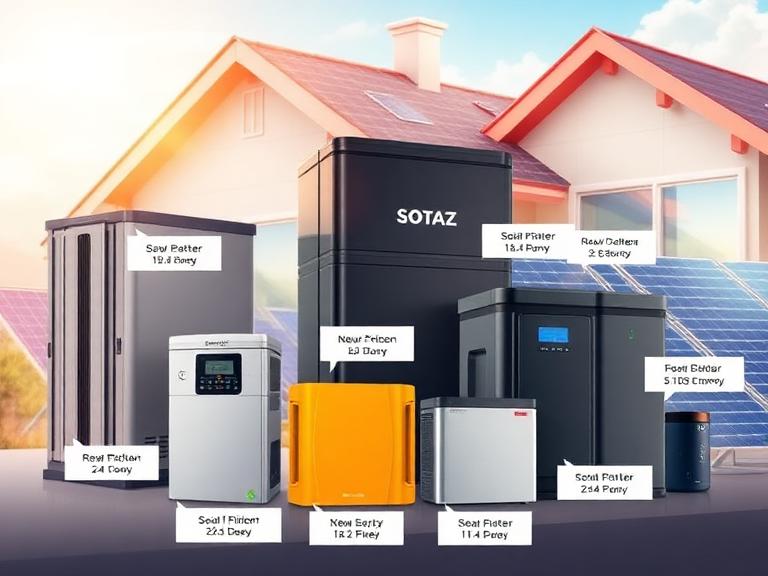
Understanding the standard modular sizes offered by leading manufacturers will help you conceptualize what size solar battery do I need to power my house. We have compiled a comparison table of the most prominent models in 2026.
| Manufacturer & Model | Usable Capacity (kWh) | Continuous Output (kW) | Scalability / Max Units |
|---|---|---|---|
| Tesla Powerwall 3 | 13.5 kWh | 11.5 kW | Up to 4 units per inverter |
| LG Chem RESU 16H | 16.0 kWh | 7.0 kW | Up to 2 units in parallel |
| Enphase IQ Battery 5P | 5.0 kWh | 3.84 kW | Highly modular microinverter architecture |
| FranklinWH aPower | 13.6 kWh | 5.0 kW | Up to 15 units |
How Many Batteries Do You Need?
A frequent misconception when assessing what size solar battery do I need to power my house is that a single unit is the only option. In reality, modern Energy Storage Components are highly scalable. Single battery setups are excellent for peak shaving and essential loads, but whole-home autonomy demands multiple battery setups wired in parallel.
For example, if your engineering audit determines you require 26 kWh of capacity and 15 kW of continuous output to start your HVAC compressor, you would install two 13.5 kWh units. This modular system approach guarantees that your power output scales linearly with your storage capacity.
Cost of Solar Batteries in 2026
Financial considerations are paramount. In 2026, the average cost per kWh for a fully installed residential lithium iron phosphate system ranges from $800 to $1,500. Total system cost estimates for a typical 13.5 kWh installation will hover between $11,000 and $18,000 before rebates.
We recommend calculating your ROI and payback period by factoring in local time-of-use (TOU) arbitrage and grid-service compensations. Furthermore, federal incentives and local tax credits can offset the total installation cost by up to 30%, making the decision of what solar battery do I need to power my house much more economically viable.
Whole-Home Backup vs Essential Loads Only
The decision that most aggressively impacts the cost of your project is choosing between whole-home backup and an essential loads panel. A “critical loads panel” involves an electrician relocating only your most vital circuits—refrigeration, security, minimal lighting—to a secondary breaker box powered by the battery.
The pros and cons comparison is simple: a critical loads setup reduces the upfront cost drastically because you only need a 10 kWh battery. Whole-home backup requires massive inverter capacities and 30+ kWh of storage, leading to a severe cost versus performance trade-off. From our experience, the critical loads panel is the most pragmatic choice for 80% of urban and suburban homeowners.
Off-Grid vs Grid-Tied Battery Sizing
If you are severing ties with the utility grid entirely, the mathematics of what size solar battery do I need to power my house change drastically. Grid-tied systems only require storage to survive temporary outages or to offset expensive evening rates. Off-grid homes require much larger systems because they must achieve multi-day autonomy to survive extended winter storms without grid fail-safes.
For true energy independence in remote locations, we frequently specify Industrial & Specialized Power configurations capable of holding 40 to 60 kWh, paired with auxiliary generators.
Common Mistakes When Choosing Battery Size
Through our consultations, we consistently observe homeowners making critical errors when deciding what size solar battery do I need to power my house:
- Undersizing storage: Buying a 5 kWh unit and expecting it to run a 4-ton central air conditioner.
- Ignoring peak power needs: Purchasing high capacity but failing to verify if the continuous kW output can handle appliance startup surges.
- Not planning for expansion: Installing a closed-loop system that prevents you from adding additional capacity when your family grows.
- Overestimating solar generation: Assuming summer irradiation levels will persist through December, leaving the battery starved during winter.
Pro Tips for Choosing the Right Battery
Expert Recommendation: Never guess your consumption. Start with a rigorous energy audit. Choose scalable systems that allow for modular expansion. Furthermore, you must consider future upgrades. If you plan to transition to electric vehicles, you must account for EV Chargers in your load calculations today. Attempting to charge an EV from a small residential battery will deplete your home’s backup reserve in a matter of hours. Always work with certified, brand-approved installers to protect your equipment warranties.
FAQs
Can one battery power a whole house?
Typically, no. A single standard 10-13.5 kWh battery is designed to power a critical loads panel. Running heavy 240V appliances like HVAC systems, electric dryers, and well pumps for a whole house usually requires stacking two to three batteries in parallel to handle the peak power demands.
How long will a solar battery last?
A modern lithium iron phosphate (LiFePO4) solar battery is engineered to last between 10 to 15 years, usually enduring 6,000 to 10,000 deep discharge cycles before degrading to 70% of its original capacity. In terms of runtime during an outage, a 10 kWh battery running essential loads will typically last 12 to 16 hours.
What happens during cloudy days?
On cloudy days, your solar panels will still generate electricity, but at a significantly reduced efficiency (often 10% to 25% of their peak output). The system will trickle-charge the battery. If consumption exceeds generation, the battery will deplete faster, and you may need to draw from the grid if you are grid-tied.
Is 10 kWh enough for a house?
When asking what size solar battery do I need to power my house, 10 kWh is sufficient if you only want to power essential circuits—such as refrigeration, internet routers, and basic lighting—overnight. It is not enough to power an entire modern home with electric heating or cooling.
Can I go completely off-grid?
Yes, but doing so requires massively oversizing both your solar array and your battery bank to ensure 3 to 5 days of autonomy during poor weather. True off-grid setups generally require 30+ kWh of storage and are significantly more expensive than grid-tied backup systems.
Do solar batteries work during power outages?
Yes. That is their primary function for most homeowners. A properly installed hybrid inverter features an automatic transfer switch (ATS) that instantly disconnects your home from the dead grid and seamlessly transitions to battery power, keeping your lights on without interruption.
Conclusion
Ultimately, answering the question of what size solar battery do I need to power my house comes down to precision mathematics. Sizing depends entirely on your daily usage profile combined with your specific backup goals. Whether you are aiming for a minimalist critical load buffer or striving for total whole-home energy independence, understanding the metrics of kW output and kWh capacity ensures you make a secure, long-term investment.
We encourage you to conduct an energy audit, review your past utility statements, and utilize the step-by-step calculation formulas provided in this guide. Do not leave your energy security to chance. We invite you to contact the engineering team at MoneyPro Energy to request a custom solar battery sizing quote tailored exactly to your home’s unique energy footprint.
Industry References
To ensure our clients have access to the most accurate and authoritative data regarding residential energy storage standards, we recommend reviewing guidelines published by federal authorities: