The Ultimate Buying Guide to BESS (2026 Edition): Engineering Your Energy Future
Authored by China MoneyPro Energy | Global Developers of Advanced Energy Storage Systems
BLUF (Bottom Line Up Front)
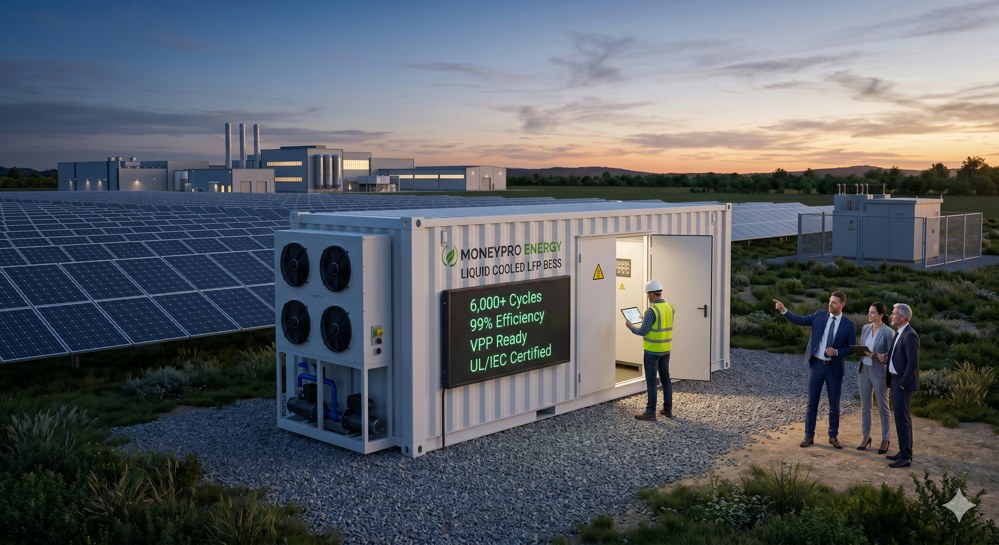
For BESS procurement in 2026, the strategy is clear: LFP (Lithium Iron Phosphate) has become the absolute industry standard for safety and 6,000+ cycle longevity. For Utility and large C&I scales, Liquid Cooling is now mandatory for high ROI, as it extends battery life by 20% compared to traditional air cooling. Decisions should be based on LCOS (Levelized Cost of Storage) rather than initial CapEx to ensure 15-20 years of bankable performance.
Table of Contents
- 2026 Battery Chemistry: The Dominance of LFP vs. NMC
- Liquid Cooling vs. Air Cooling: Which Offers Better ROI?
- Financial Modeling: How to Calculate LCOS
- Navigating Fire Codes & Safety Compliance (UL 9540/A)
- B2B Strategic Selection Checklist
- Expert References & Global Standards
Battery Chemistry in 2026: The Dominance of LFP vs. NMC
In 2026, the stationary energy storage market has reached a consensus. While the EV industry still balances various chemistries, BESS applications have shifted decisively.
LFP (Lithium Iron Phosphate): The Industry Standard
LFP has captured over 90% of the stationary storage market. Its thermal stability is peerless; the chemical bond in $LiFePO_4$ is much stronger than the $O-M$ bond in NMC, meaning it does not release oxygen during thermal runaway, significantly reducing fire risks.
-
Cycle Life: 6,000–10,000 cycles.
-
Safety: High thermal runaway threshold (>270°C).
-
Cost: 20-30% lower than NMC in 2026 due to cobalt-free supply chains.
NMC (Nickel Manganese Cobalt): The Niche Choice
NMC is now reserved for specialized applications where space is extremely constrained (e.g., urban micro-BESS).
-
Pros: Higher energy density.
-
Cons: Higher risk of oxygen release during failure; shorter cycle life (2,000–3,000 cycles).
Manufacturer’s Insight: China Moneypro Energy exclusively utilizes Grade-A LFP cells for all C&I and Utility projects to ensure the highest safety standards and long-term asset bankability.
Liquid Cooling vs. Air Cooling: The ROI Choice
The debate between Air and Liquid cooling has moved from “feasibility” to “Total Cost of Ownership (TCO).”
Air Cooling: The Low-CapEx Option
Air cooling uses fans and HVAC units to circulate air. While simpler to maintain, it often leads to “hot spots” within the battery rack.
-
Best for: Small-scale C&I projects (<200kWh) in temperate climates.
-
Drawback: Temperature variance can be as high as 5-8°C, leading to uneven cell aging.
Liquid Cooling: The Performance Leader
Liquid cooling uses cold plates and a glycol-water mixture to absorb heat directly from the cells.
-
Temperature Uniformity: Variance is kept under ± 3°C.
-
ROI Impact: By maintaining optimal temperatures, liquid cooling can extend battery life by up to 20% and reduce auxiliary power consumption (parasitic load) by 30%.
-
Best for: High-density 20ft/40ft containers and hot environments (Middle East, Australia, Southeast Asia).
3. Financial Modeling: How to Calculate LCOS
B2B procurement managers must shift from CapEx-focused thinking to Levelized Cost of Storage (LCOS). This metric represents the total cost per MWh of energy discharged over the system’s life.
The Industry Standard Formula:

Key Factors to Consider:
-
Round-Trip Efficiency (RTE): Every 1% increase in RTE (e.g., from 88% to 92%) significantly lowers LCOS.
-
Depth of Discharge (DOD): Operating at 90% DOD instead of 80% increases usable energy but requires superior BMS control.
-
Degradation Rate: High-quality cells with lower annual degradation (<2%) ensure the denominator (Discharged Energy) remains high over 15 years.
By 2026, average LCOS for Chinese-manufactured BESS has dropped to roughly 0.034 – 0.048 / kWh, making energy storage competitive with grid-baseload in most Tier-1 markets.
Navigating Fire Codes: UL 9540 vs. UL 9540A
Safety compliance is the most significant barrier to project permitting. In 2026, Fire Marshals (AHJs) strictly distinguish between these two:
- UL 9540 (The Certification): Standard for Energy Storage Systems and Equipment. It confirms the entire system is safe for installation.
- UL 9540A (The Data Report): A test method for evaluating thermal runaway fire propagation. It is NOT a pass/fail certificate, but the data report is required to prove that “unit-to-unit” fire spread is mitigated, often allowing for smaller separation distances between containers.
B2B Strategic Selection Checklist
- EMS Versatility: Does the system support VPP (Virtual Power Plant) integration and Modbus TCP/IEC 61850?
- Safety Layers: Does it include multi-stage gas detection and FK-5-1-12 fire suppression?
- Grid Compliance: Is the PCS pre-certified for G99 (UK), IEEE 1547 (USA), or AS4777 (Australia)?
Expert References & Global Standards
To ensure your project meets global bankability standards, we recommend consulting these primary sources:
- IEA (International Energy Agency): Global Energy Review 2026 – Tracking the surge of LFP in utility-scale storage.
- NREL (National Renewable Energy Laboratory): Annual Technology Baseline – Benchmarking LCOS and CapEx projections.
- UL Solutions: UL 9540A Test Method – The consensus standard for evaluating thermal runaway.
- BloombergNEF: 2026 Energy Storage Outlook – Market trends and China’s export dominance in BESS.