How to Integrate Hybrid Inverters into Existing Solar Arrays
As the global energy landscape shifts toward self-consumption and grid stability, the demand for retrofitting existing photovoltaic (PV) systems with energy storage has reached an all-time high. For retrofit specialists and solar installers, the core challenge lies in seamlessly integrating hybrid inverters into legacy arrays without compromising system integrity or safety certifications. This deep-dive guide explores the technical architectures, hardware requirements, and factory-level insights necessary to execute high-performance storage upgrades.
Executive Summary: Retrofitting hybrid inverters allows existing PV owners to unlock time-of-use (ToU) optimization and backup power by utilizing either AC-coupled or DC-coupled architectures, leveraging high-efficiency power electronics to manage bi-directional energy flow.
Key Takeaways for Installers
- Architecture Choice: AC-coupling is the industry standard for retrofitting systems where the existing string inverter remains functional.
- Certification Compliance: Ensure all hybrid hardware meets UL 1741 SB or G98/99 standards to maintain grid interconnection legality.
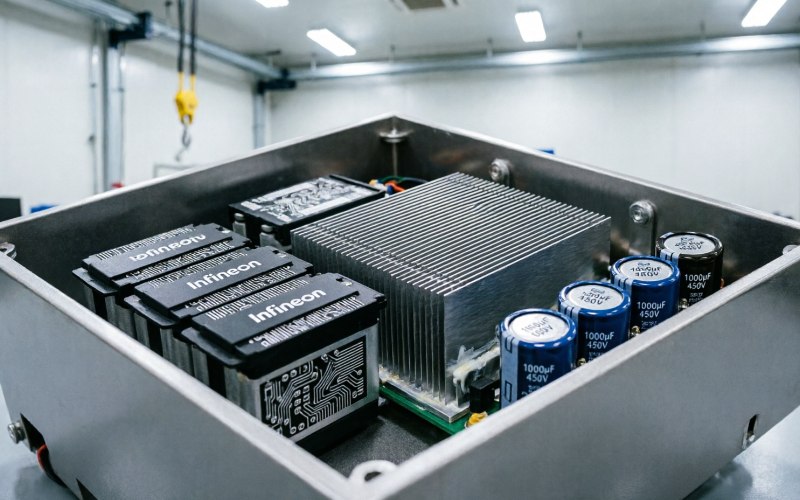
- Component Quality: Factory-direct hybrid inverters using Infineon IGBTs and Japanese capacitors (e.g., Nippon Chemi-Con) provide superior longevity under high C-rate cycling.
- System Efficiency: DC-coupled retrofits offer 3-5% higher round-trip efficiency by reducing DC-AC conversion stages.
The Technical Imperative of Hybrid Integration
Integrating a hybrid inverter into an existing array transforms a unidirectional generation plant into a smart, bi-directional energy node capable of grid services, peak-shaving, and black-start functionality.
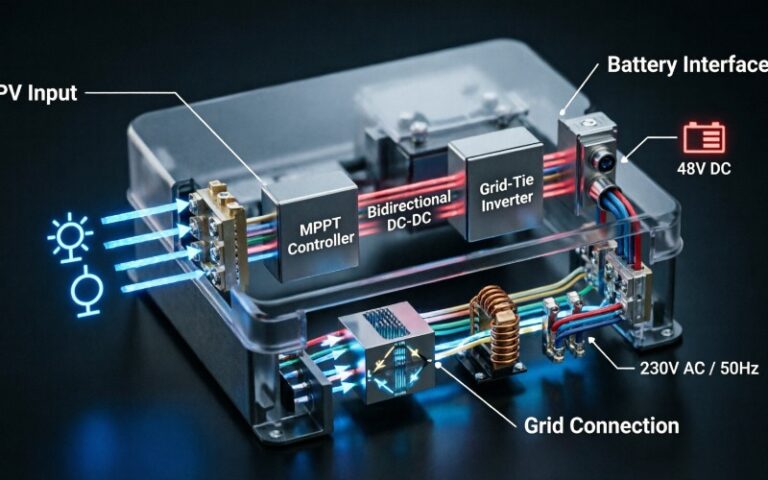
In the current B2B landscape, commercial and industrial (C&I) clients are no longer satisfied with mere solar generation. They require energy security and the ability to participate in Virtual Power Plants (VPP). Unlike standard string inverters from brands like Sungrow or GoodWe that only convert DC to AC, a hybrid inverter acts as the central EMS (Energy Management System) hub. It manages the delicate balance between the PV array, the battery bank (typically LFP chemistry), the local loads, and the utility grid.
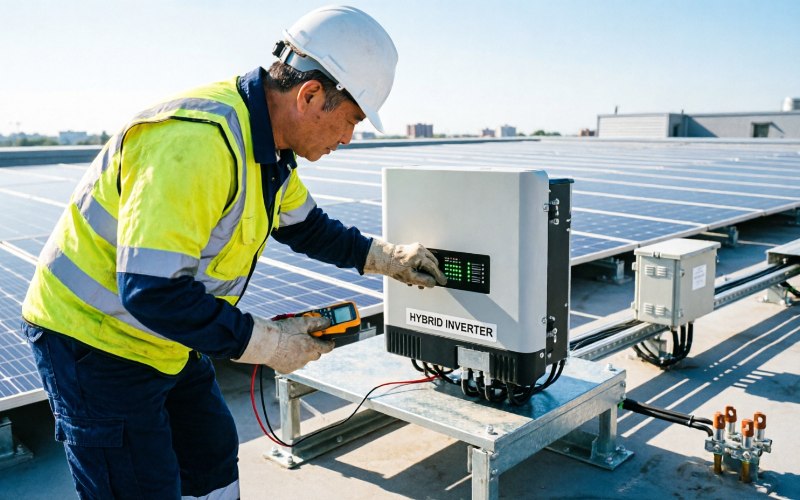
From a manufacturing perspective, the integration must handle transient voltage surges and harmonic distortion (THDi < 3%). High-quality hybrid units must feature robust MPPT algorithms with 99.9% efficiency to ensure that even when integrated with older, slightly degraded panels, the power harvest is maximized. Furthermore, the integration process must account for the existing system’s grounding and AFCI (Arc Fault Circuit Interrupter) settings to prevent nuisance tripping, a common issue in brownfield retrofits.
AC-Coupling vs. DC-Coupling: Choosing the Right Path
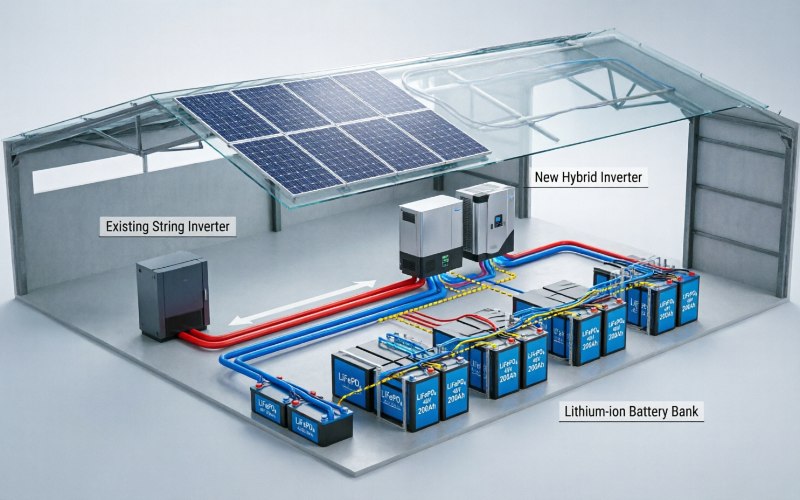
AC-coupling is the most cost-effective retrofit strategy for existing solar arrays as it allows the original inverter to remain in place, simply adding a battery-connected inverter to the AC bus.
Deep Dive into AC-Coupled Systems
In an AC-coupled configuration, the existing PV inverter continues to convert DC power from the panels into AC. The new hybrid inverter (or battery inverter) is connected to the same AC switchboard. When PV production exceeds local demand, the hybrid inverter converts that excess AC back into DC to charge the LFP battery bank. This ‘double conversion’ (DC to AC, then AC to DC) introduces a slight efficiency loss, usually around 2-4% compared to DC-coupled systems. However, the advantage is significant: you do not need to touch the existing DC wiring or high-voltage string configurations, which is critical for maintaining the original installer’s warranty and system certification.
For high-demand environments, we utilize power-dense bi-directional PCS (Power Conversion Systems) that can handle high surge currents. These units must be programmed with frequency-watt control functions. When the grid goes down (off-grid mode), the hybrid inverter creates an AC microgrid. By shifting the frequency (e.g., from 50Hz to 52Hz), it signals the existing PV inverter to throttle its output, preventing the battery from being overcharged—a technique known as ‘Frequency Shift Power Control’.
Deep Dive into DC-Coupled Retrofits
DC-coupled retrofits are more invasive but technically superior for long-term ROI. In this scenario, the existing string inverter is removed and replaced entirely with a high-capacity hybrid inverter. The existing PV strings are landed directly into the new inverter’s MPPT trackers. This eliminates the redundant AC-DC conversion stage, allowing the PV energy to flow directly into the battery (DC-to-DC). This architecture is particularly favored in utility-scale or large C&I projects where every percentage point of round-trip efficiency translates into thousands of dollars in annual savings.
As a factory specializing in these core components, we ensure our DC-coupled hybrid inverters have a wide MPPT voltage range (e.g., 200V – 1000V) to accommodate various legacy string lengths. We also integrate advanced BMS communication protocols (CAN/RS485) to ensure compatibility with a wide range of battery manufacturers, though we always recommend our proprietary LFP stacks for optimized C-rate performance and thermal management.
Technical Comparison: Retrofit Options
| Feature | AC-Coupled Retrofit | DC-Coupled Replacement |
|---|---|---|
| Installation Time | Fast (1-2 days) | Moderate (2-4 days) |
| Round-trip Efficiency | 88% – 92% | 94% – 97% |
| Legacy Inverter Status | Retained | Removed/Replaced |
| DC Wiring Modification | None | Required |
| Scalability | High (Add more AC units) | Limited by MPPT inputs |
| Best Application | Newer Residential/Small C&I | Old Inverters / High-Efficiency Needs |
Manufacturing Standards and Reliability: The Factory Perspective
B2B reliability is built on component selection; Moneypro Energy utilize Infineon IGBTs and perform 48-hour high-temperature aging tests to ensure all retrofitted hybrid units withstand 6,000+ battery cycles.
When an installer selects a hybrid inverter for a retrofit, they are betting on the device’s ability to operate 24/7 as the system’s brain. Cheap consumer-grade components cannot handle the thermal stress of constant cycling. Our factory-level quality control includes X-ray inspection of PCB solder joints and the use of IP66-rated enclosures to prevent moisture ingress in harsh environments. We also focus on ‘Information Gain’—our internal testing data shows that using Nippon Chemi-Con electrolytic capacitors extends the inverter’s lifespan by 30% compared to standard Tier-2 alternatives.
Furthermore, compliance with global standards like UL 1741 SB and IEEE 1547.1 is non-negotiable. These certifications ensure that during grid disturbances, the hybrid inverter can provide ‘Ride-Through’ capabilities, supporting the grid rather than simply disconnecting. For the installer, this means fewer O&M calls and a system that is future-proofed against changing utility regulations.
Frequently Asked Questions
Can I integrate a hybrid inverter with any existing solar panel brand?
What is the maximum battery capacity I can add during a retrofit?
Does retrofitting void the existing PV system warranty?