What Is a Hybrid Inverter?
Executive Summary: A hybrid inverter is a multi-mode power conversion system (PCS) that synchronizes solar PV, battery storage, and grid interaction. For distributors, it represents the core of a future-proof Energy Storage System (ESS), enabling peak-shaving, VPP readiness, and maximum energy independence.
Table of Contents
- Defining the Hybrid Inverter: The Heart of Modern ESS
- Key Technical Takeaways
- Technical Architecture: DC-Coupled vs. AC-Coupled Logic
- Internal Componentry: From Infineon IGBTs to DSP Control
- Performance Benchmark: Hybrid vs. String vs. Off-Grid
- Commercial ROI: Peak Shaving and VPP Readiness
- Manufacturing Excellence: Testing Protocols for Global Compliance
- Frequently Asked Questions (FAQ)
- Wholesale & Procurement CTA
Key Takeaways for Procurement Managers
- Multi-Directional Conversion: Hybrid inverters manage DC-to-AC and AC-to-DC flows simultaneously, eliminating the need for separate chargers.
- Grid-Forming Capability: Advanced hybrid units provide true backup power (UPS-level) during grid outages with <10ms switching times.
- System Scalability: Modern units support parallel configurations (up to 15 units) for C&I applications.
- Bankability: High-quality components (e.g., Japanese Black Edition capacitors) ensure a 10-15 year design life.
Defining the Hybrid Inverter: The Heart of Modern ESS
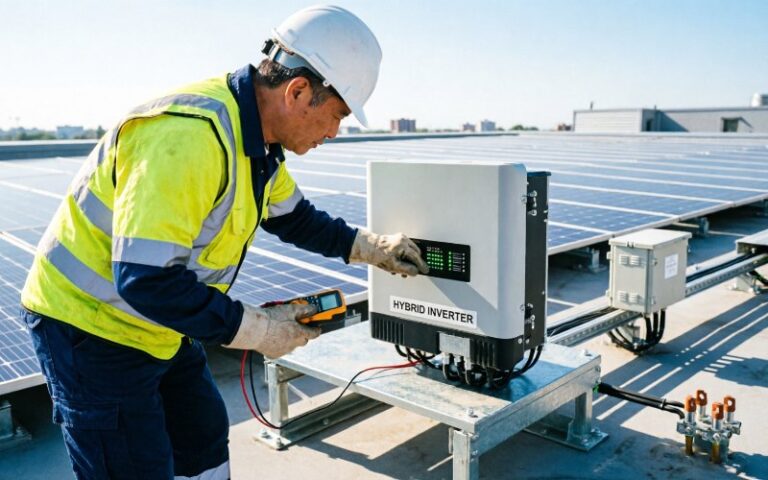
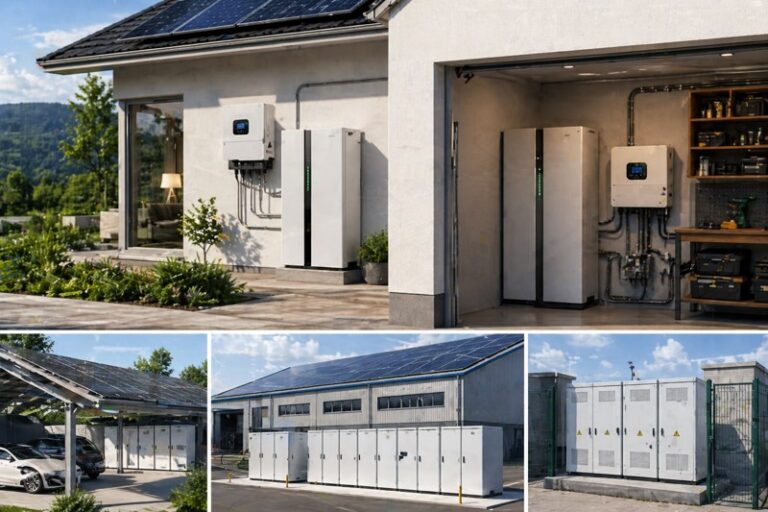
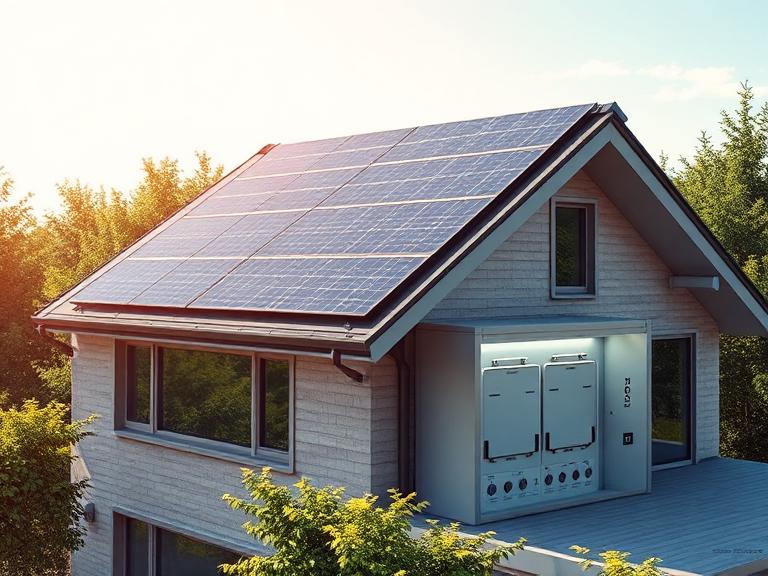
A hybrid inverter (also known as a multi-mode inverter) is a sophisticated power electronics device that integrates a solar inverter and a battery inverter into a single unit, managing energy from PV panels, lithium batteries, and the utility grid simultaneously.
In the evolving landscape of 2026, the hybrid inverter has moved beyond simple energy conversion. It is now the central intelligence unit of a Residential or C&I (Commercial & Industrial) Energy Storage System. Unlike traditional string inverters used by industry giants like Sungrow or SMA in large-scale utility farms, hybrid inverters are designed for flexibility. They allow end-users to maximize self-consumption (Self-Use Mode), participate in Demand Response programs, and maintain power during grid instability.
For distributors, the value proposition lies in the reduction of Balance of System (BoS) costs. By integrating the charge controller, inverter, and battery management interface, installation complexity is reduced by 30-40%. This “all-in-one” approach is what differentiates a premium factory-direct solution from legacy component-based systems. Our R&D focus remains on high-efficiency conversion, reaching 98.4% Euro-efficiency, ensuring minimal thermal loss during the bi-directional power exchange.
Technical Architecture: DC-Coupled vs. AC-Coupled Logic
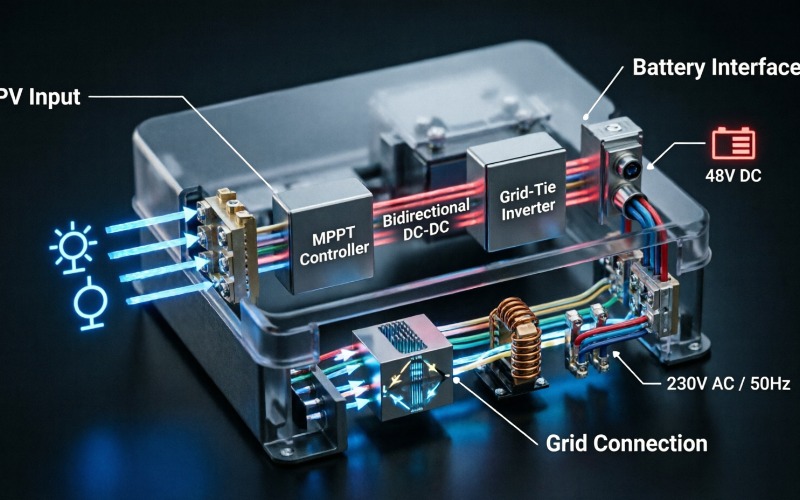
Hybrid inverters primarily utilize DC-coupled architecture to achieve superior round-trip efficiency by reducing the number of power conversion stages from three to one.
When analyzing the technical stack, procurement managers must distinguish between DC and AC coupling. In a DC-coupled hybrid system, the electricity from the PV array flows directly into the battery via a DC-DC converter. This prevents the efficiency losses associated with converting DC to AC and back to DC (a common issue in retrofitted systems using GoodWe or Victron AC-coupled setups). Our hybrid models utilize high-voltage battery interfaces (typically 150V-800V), which significantly reduce I2R (ohmic) losses in the cables, allowing for higher discharge C-rates.
The integration of sophisticated MPPT (Maximum Power Point Tracking) algorithms is crucial. With dual or triple MPPT trackers, our inverters can handle complex roof orientations and shading. The MPPT efficiency of 99.9% ensures that even in low-light conditions, the DC-DC stage maximizes the energy harvested for battery storage. This technical granularity is what enables an installer to guarantee a specific ROI to the end-user, especially in markets with high electricity volatility.
Internal Componentry: From Infineon IGBTs to DSP Control
The reliability of a hybrid inverter is determined by its internal power semiconductors and thermal management systems, specifically the use of Automotive-grade IGBTs and high-speed Digital Signal Processors (DSPs).
At the factory level, we don’t settle for generic components. We utilize Infineon or Wolfspeed SiC (Silicon Carbide) MOSFETs/IGBTs, which offer higher switching frequencies and lower switching losses compared to traditional silicon. This allows for a more compact design with IP66-rated enclosures, suitable for harsh outdoor environments. Furthermore, our DC link utilizes Japanese United Chemi-Con (Black Edition) capacitors, which are rated for 105°C and have a significantly longer lifespan than standard electrolytic alternatives.
The control logic is driven by Texas Instruments (TI) C2000 series DSPs. This allows for real-time monitoring of the grid waveform, enabling AFCI (Arc Fault Circuit Interrupter) protection and Rapid Shutdown compliance (UL 1741 SB / NEC 2020). By sampling the current and voltage at kilohertz rates, the inverter can detect a DC arc within milliseconds and shut down the system, preventing fire hazards—a critical selling point for premium distribution channels.
Performance Benchmark: Hybrid vs. String vs. Off-Grid
| Feature | Hybrid Inverter (ESS) | String Inverter (On-Grid) | Off-Grid Inverter |
|---|---|---|---|
| Grid Connection | Bi-directional | Unidirectional (Export) | No Grid Connection |
| Battery Storage | Integrated Interface | Not Supported | Mandatory |
| Backup Power | Seamless (<10ms) | No (Safety Shutdown) | Full Time |
| Energy Management | EMS / Peak Shaving | Basic Monitoring | Load Prioritization |
| Typical Efficiency | 97.5% – 98.4% | 98.0% – 99.0% | 90.0% – 94.0% |
| Max Voltage (Vdc) | 600V – 1000V | 1000V – 1500V | 150V – 500V |
Commercial ROI: Peak Shaving and VPP Readiness
Modern hybrid inverters serve as financial optimization tools by utilizing Peak Shaving and Virtual Power Plant (VPP) integration to reduce the Levelized Cost of Storage (LCOS).
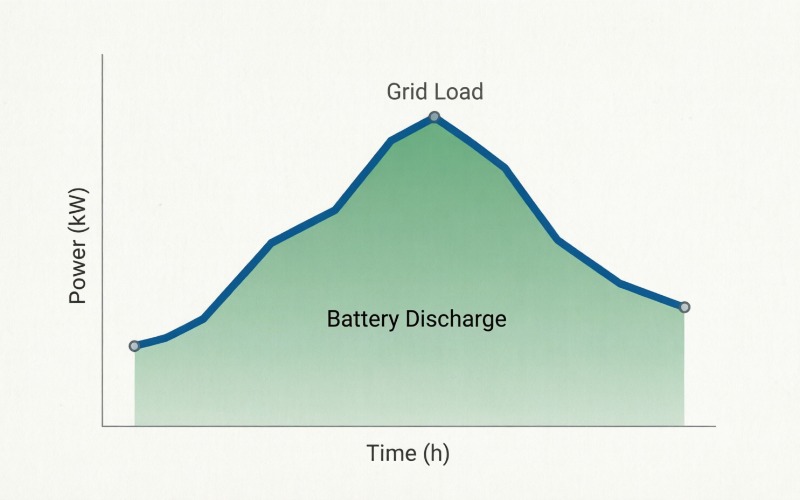
For C&I customers, the primary pain point is high demand charges. A hybrid inverter can be programmed for “Peak Shaving,” where the battery discharges during periods of high peak load to keep the grid draw below a certain threshold. This can save thousands of dollars in monthly utility fees. Furthermore, our EMS (Energy Management System) is VPP-ready, supporting protocols like SunSpec Modbus and IEEE 2030.5. This allows distributors to sell systems that can eventually participate in grid stabilization markets, earning the owner additional revenue.
The scalability factor is also vital. Our 50kW-100kW hybrid units can be paralleled to create multi-megawatt-hour systems. Unlike residential-only brands, our factory designs focus on thermal stability under continuous high-power discharge (1C rate), ensuring that the system doesn’t de-rate its output even when ambient temperatures reach 45°C. This robustness is essential for the Middle East, Australian, and Southern US markets where heat is the primary enemy of power electronics.
Manufacturing Excellence: Testing Protocols for Global Compliance
Quality assurance in hybrid inverter manufacturing requires rigorous 48-hour high-temperature aging tests and full-load validation across all operational modes before shipment.
As a leading OEM/ODM factory, we understand that reliability is the cornerstone of a distributor’s reputation. Our manufacturing facility follows ISO 9001/14001 standards, but our internal QC goes further. Every inverter undergoes an Automated Optical Inspection (AOI) for PCB assembly, followed by a functional test that simulates grid faults, battery communication errors, and PV overvoltage. We also perform a “burn-in” test at 50°C for 48 hours to weed out early-life component failures (infant mortality).
Certification is another non-negotiable. Our products carry TUV, CE, UKCA, and UL 1741 SB certifications. For the UK market, we ensure G98/G99 compliance; for Italy, CEI 0-21. This global compliance footprint means distributors can source a single, reliable platform and customize it for different regional grid codes through our firmware, reducing the need for multiple SKUs and complex inventory management.
Frequently Asked Questions (FAQ)
Can a hybrid inverter work without a battery?
What is the typical switching time for backup power?
Does it support unbalanced three-phase loads?
Scale Your Solar Business with Factory-Direct Expertise
Looking for a reliable OEM/ODM partner to dominate your local ESS market?
As a specialized factory, Moneypro Energy offers high-margin opportunities for distributors and procurement managers looking for Tier-1 quality without the brand-name markup. Our engineering team provides full system design support, from residential LFP battery integration to megawatt-scale C&I projects.
Contact our technical sales team today for a wholesale price list and full technical datasheet.