Hybrid Inverter vs. String Inverter: The Definitive Technical Guide for Solar EPCs and Distributors
In the rapidly evolving landscape of global energy transition, the choice between hybrid and string inverter architectures determines the long-term bankability and operational efficiency of solar assets. As a leading manufacturer at Moneypro Energy, we recognize that for installers and wholesalers, this isn’t just a technical preference—it’s a strategic decision affecting System Average Interruption Duration Index (SAIDI) and overall Levelized Cost of Energy (LCOE).
Executive Summary: While string inverters remain the cost-effective choice for pure grid-tied generation in large-scale utility projects, hybrid inverters are now the mandatory standard for resilience-focused C&I and residential applications, offering integrated DC-coupled storage management and advanced grid services like peak-shaving.
Key Takeaways for B2B Decision Makers
- Hybrid Architecture: Best for projects requiring UPS-grade backup (switching <10ms) and high self-consumption rates.
- String Architecture: Optimized for high-density PV arrays where energy storage is not a current or future requirement.
- Efficiency Metrics: Look for MPPT efficiency >99.9% and Euro efficiency >97.5% to ensure maximum ROI.
- Component Quality: Moneypro Energy utilizes Infineon IGBTs and Japanese Nippon Chemi-Con capacitors to guarantee a 25-year design life.
- Regulatory Compliance: Ensure hardware supports UL 1741 SB, CE LVD/EMC, and local grid codes like G98/G99.
Table of Contents
- What Is the Core Difference Between Hybrid and String Inverters?
- How Does a Hybrid Inverter Manage Bidirectional Power Flow?
- Why String Inverters Dominate Large-Scale Generation
- Technical Efficiency: MPPT Accuracy and Conversion Losses
- Information Gain: Moneypro Energy’s Manufacturing Excellence
- Technical Specification Comparison
- ROI Analysis: CAPEX vs. OPEX in B2B Scenarios
- Frequently Asked Questions
What Is the Core Difference Between Hybrid and String Inverters?
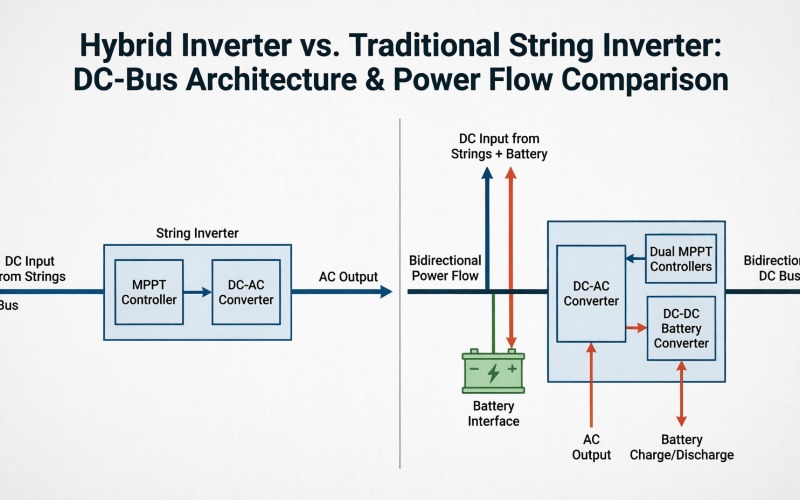
A hybrid inverter is a multi-mode power conversion system (PCS) that manages inputs from both PV arrays and battery storage, whereas a string inverter is a unidirectional device designed solely to convert DC from solar panels into grid-compliant AC.
Understanding the fundamental topology is critical for EPCs. A standard string inverter, similar to those pioneered by industry stalwarts like Sungrow or GoodWe, operates on a simple premise: maximizing yield from the PV strings through high-speed MPPT tracking. However, these units lack the DC-DC conversion stages necessary to interface with high-voltage battery systems. If a client later decides to add storage to a string-based system, they must perform an “AC-coupling” retrofit, which introduces redundant conversion stages (DC-AC then AC-DC), leading to cumulative energy losses of 5-8%.
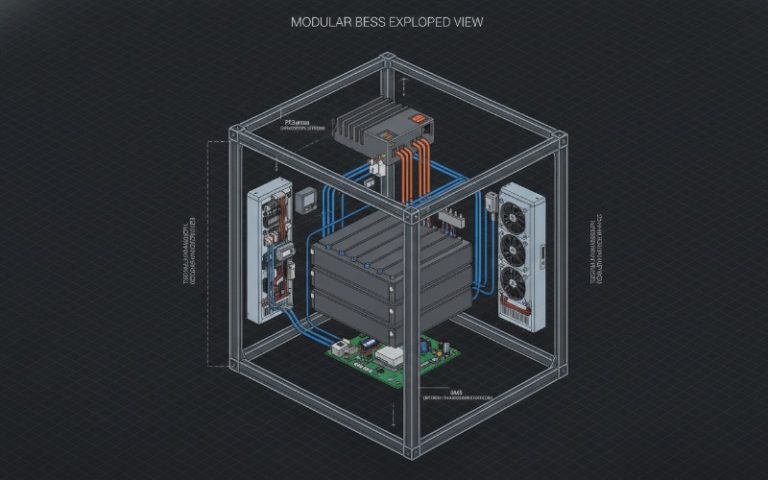
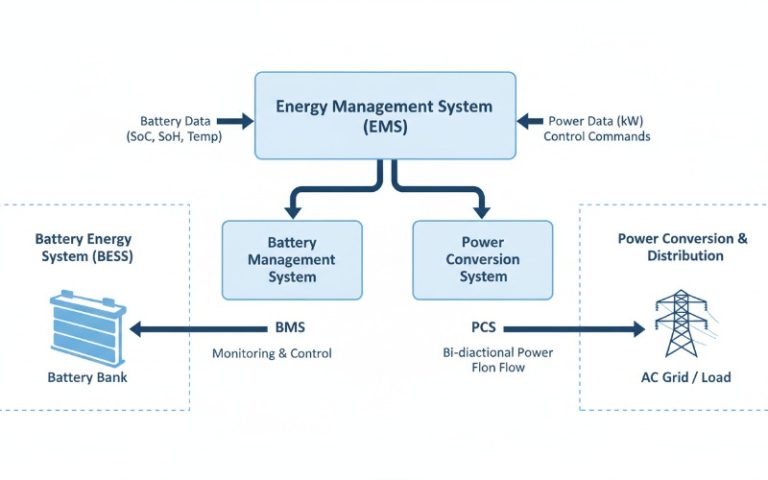
In contrast, Moneypro Energy’s hybrid series integrates a sophisticated Battery Management System (BMS) communication gateway (supporting CAN/RS485) directly into the inverter chassis. This allows for “DC-coupling,” where energy flows directly from the PV panels into the LFP battery bank through an internal DC-DC bus. By eliminating unnecessary inversion cycles, our hybrid systems achieve round-trip efficiencies that significantly outperform AC-coupled string alternatives.
How Does a Hybrid Inverter Manage Bidirectional Power Flow?
Hybrid inverters utilize an integrated bidirectional DC-DC converter and a four-quadrant inverter bridge to facilitate simultaneous power routing between PV, Battery, Grid, and Load.
The engineering complexity of a hybrid inverter far exceeds that of a string unit. At the heart of Moneypro Energy’s hybrid systems is a high-speed DSP (Digital Signal Processor) that executes control loops at microsecond intervals. This allows the system to manage complex scenarios such as Peak Shaving—where the battery discharges to prevent the facility from exceeding its contracted power capacity from the utility, directly reducing demand charges.
Technical installers must pay attention to the C-rate compatibility. Our hybrid units are designed to handle 1C continuous discharge rates, ensuring that when the grid fails, the transition to “Islanding Mode” (Off-grid) is seamless. By utilizing Infineon CoolSiC™ MOSFETs and IGBT modules, we minimize Total Harmonic Distortion (THDi) to <3%, ensuring that sensitive medical or IT equipment in C&I settings remains protected from power quality issues. This level of power electronics density is what differentiates premium OEM manufacturing from entry-level consumer grade products.
Why String Inverters Remain the Gold Standard for Large-Scale Utility Projects
String inverters offer superior scalability and a lower initial CAPEX for utility-scale projects where on-site energy storage is not a requirement for the PPA (Power Purchase Agreement).
Despite the rise of storage, string inverters like the Moneypro String Series (up to 250kW) are the backbone of utility solar. Their primary advantage is Granular MPPT Tracking. In large fields with varying topography or potential shading, having multiple MPPTs (often up to 12-16 per unit) ensures that the entire array isn’t dragged down by the performance of a single underperforming string. This is a critical factor for solar farms where 0.1% efficiency gains translate into millions of dollars over the project’s life.
Furthermore, string inverters are easier to service (O&M). In a centralized architecture, a single failure can take down megawatts. In a string architecture, a failure only impacts a small fraction of the plant. Our string inverters feature IP66 ingress protection and C5-level anti-corrosion, making them suitable for harsh environments from floating solar to desert installations. They are designed for one purpose: maximum AC throughput at the lowest possible cost per watt.
Technical Efficiency: MPPT Accuracy and Conversion Losses
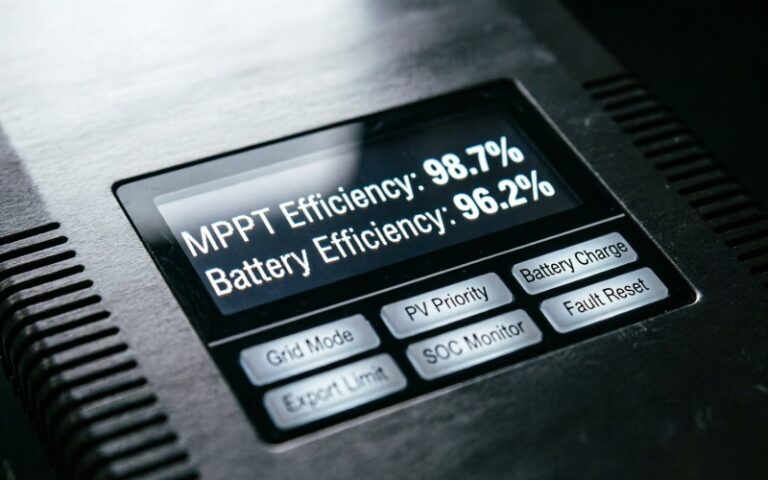
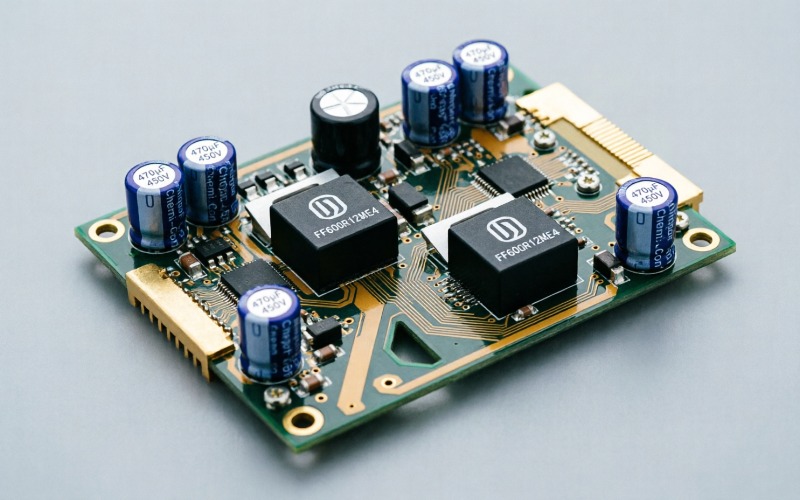
Modern hybrid inverters have closed the efficiency gap with string inverters, now offering static MPPT efficiencies of 99.9% and maximum conversion efficiencies exceeding 98%.When comparing Moneypro Energy units to competitors like SMA or Fronius, the differentiator lies in the thermal management and the quality of the passive components. Efficiency isn’t just a number on a datasheet; it’s a measure of heat generation. Excessive heat is the primary killer of power electronics. We utilize Japanese Nippon Chemi-Con aluminum electrolytic capacitors, which are rated for 105°C and provide significantly higher ripple current resistance than standard components.
In C&I applications, the CEC Efficiency (California Energy Commission) is the gold standard for comparison. While string inverters typically edge out hybrids by 0.5% in pure DC-AC conversion, the hybrid system wins in total System Efficiency when storage is involved. By avoiding the double-conversion loss of AC-coupled systems, a Moneypro Hybrid system can deliver up to 10% more usable energy from the same battery capacity over a 24-hour cycle.
Information Gain: Moneypro Energy’s Manufacturing Excellence
Every Moneypro Energy inverter undergoes a rigorous 48-hour high-temperature full-load aging test at 50°C before leaving the factory to eliminate infant mortality in power electronics.
As an OEM/ODM partner, we provide transparency that others hide. Our manufacturing facility utilizes fully automated SMT (Surface Mount Technology) lines and AI-driven AOI (Automated Optical Inspection) to ensure every solder joint meets IPC-A-610 Class 3 standards. We don’t just assemble; we engineer. For instance, our PCBAs are treated with a triple-proof conformal coating (anti-salt spray, anti-humidity, anti-dust), which is essential for projects in coastal regions or high-pollution industrial zones.
Technical Specification Comparison
| Feature | Moneypro Hybrid (5-20kW) | Moneypro String (50-250kW) |
|---|---|---|
| Application | Residential / Light C&I + Storage | Utility Scale / Large C&I |
| Max. Efficiency | 98.2% | 99.0% |
| MPPT Quantity | 2 – 4 | 10 – 15 |
| Storage Interface | Integrated (HV LFP Support) | External AC-Coupling Only |
| Backup Function | Integrated (UPS <10ms) | No (Grid-tied only) |
| Communication | CAN, RS485, WiFi, 4G, LAN | RS485, PLC, 4G |
| Protection | AFCI, Type II SPD, IP66 | AFCI, Type I+II SPD, IP66 |
ROI Analysis: CAPEX vs. OPEX in B2B Scenarios
While a hybrid inverter carries a 20-30% CAPEX premium over a string inverter of equivalent AC capacity, the reduction in demand charges and increased self-consumption typically result in a 2-year shorter payback period.
For distributors and installers, selling a hybrid solution is an exercise in value-based selling. In regions with high Time-of-Use (ToU) tariffs, the ability of a hybrid system to shift solar generation from midday to evening peak hours is the primary driver of ROI. Furthermore, with the emergence of Virtual Power Plants (VPPs), hybrid systems become revenue-generating assets, allowing owners to sell stored energy back to the grid during frequency regulation events.
From an O&M perspective, Moneypro’s cloud-based monitoring platform provides string-level diagnostics. This allows technicians to identify a failing module or a loose connector remotely, reducing truck rolls. For our OEM partners, we provide a white-labeled version of this platform, allowing you to maintain your brand’s touchpoint with the end-user while leveraging our robust backend infrastructure.
Frequently Asked Questions
Can a string inverter be upgraded to a hybrid system later?
Yes, but it requires an AC-coupled storage inverter (PCS). This increases the system complexity, takes up more wall space, and is less efficient than starting with a hybrid inverter if storage is part of the long-term plan.
What is the typical lifespan of a Moneypro Hybrid Inverter?
Our inverters are designed for a 25-year technical lifespan. We provide a standard 5-year warranty, extendable to 10 or 15 years, backed by our use of tier-1 industrial components and rigorous thermal management.
Do your inverters support 100% unbalanced three-phase loads?
Absolutely. Our three-phase hybrid series supports 100% unbalanced output, meaning you can run a heavy single-phase load on Phase A without affecting the stability of Phase B and C—a critical feature for older commercial buildings.
Are Moneypro Energy inverters compatible with all lithium batteries?
We are compatible with most leading high-voltage LFP brands (e.g., Pylontech, BYD). We also offer our own optimized LFP battery modules for a true plug-and-play experience with guaranteed BMS synchronization.
Partner with Moneypro Energy for Your Next Project
For Wholesalers & Distributors: Access factory-direct pricing and priority lead times on our complete range of certified hybrid and string inverters. Scale your inventory with a reliable OEM partner.
For EPCs & Installers: Need a custom solution for a complex C&I project? Our engineering team provides full system design support, from SLD (Single Line Diagrams) to commissioning guidance.
Get a Quote Today: Contact our B2B sales department for a comprehensive price list and technical catalog. Let’s build the future of energy together.
LSI Keywords: Solar Energy Storage, Bidirectional Inverter, PV Inverter Manufacturer, C&I Solar Solutions, LFP Battery Compatibility, Grid-tied Inverter vs Hybrid.
Reference Authority: For more on global inverter standards, visit International Electrotechnical Commission (IEC) or Underwriters Laboratories (UL).