PCS vs BMS vs EMS
Executive Summary: For B2B system integrators and EPCs, understanding the interplay between the Power Conversion System (PCS), Battery Management System (BMS), and Energy Management System (EMS) is critical for maximizing ROI, ensuring UL/CE compliance, and delivering bankable utility-scale or C&I energy storage solutions.
Key Takeaways for Decision Makers
- PCS (The Muscle): Executes bidirectional AC/DC conversion with focus on grid-following/forming and THDi control.
- BMS (The Guardian): Monitors LFP cell health, SOX (SOC, SOH, SOP) metrics, and manages safety trip-curves.
- EMS (The Brain): Orchestrates system-wide logic, from peak-shaving to VPP market participation via Modbus/TCP or CANbus.
- Integration: Seamless communication between these three tiers determines system latency and O&M costs over a 10-15 year lifecycle.
Table of Contents
- What is the Core Architecture of a Utility-Scale BESS?
- How Does the Power Conversion System (PCS) Regulate Bidirectional Energy Flow?
- Why is the Battery Management System (BMS) the Gateway to Functional Safety?
- When Does the Energy Management System (EMS) Become the Project’s Brain?
- PCS vs BMS vs EMS: A Technical Comparison for System Integrators
- Optimizing Components for Factory Energy Storage Solutions
- Frequently Asked Questions
What is the Core Architecture of a Utility-Scale BESS?
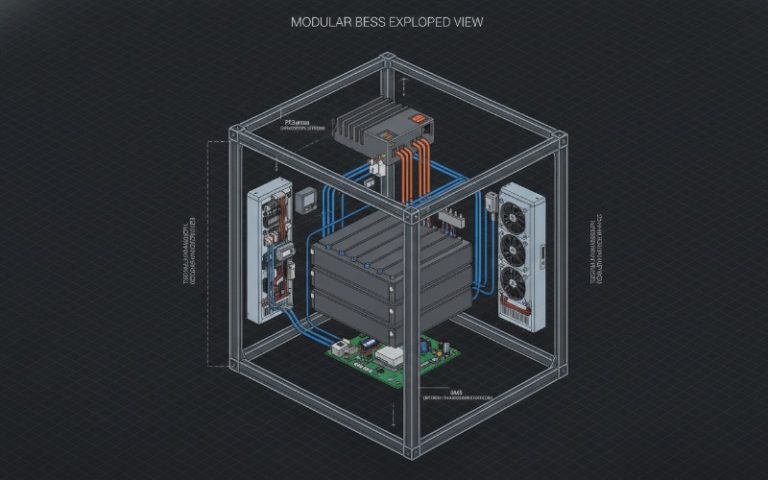
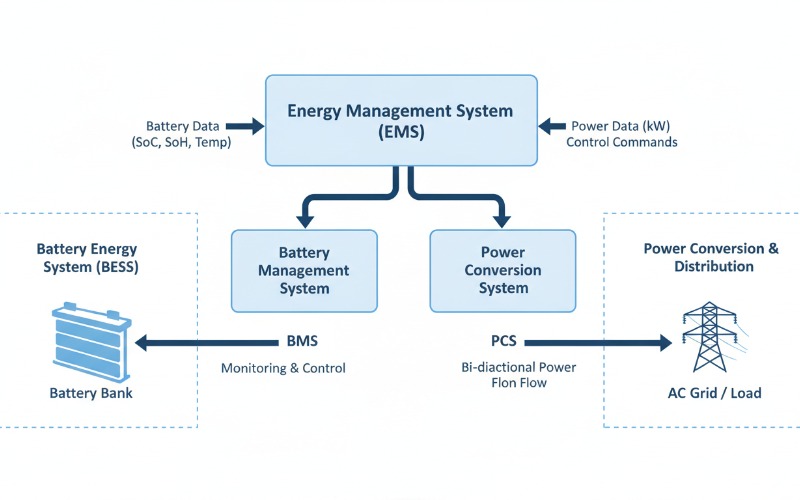
The modern Battery Energy Storage System (BESS) is a multi-layered ecosystem where the PCS, BMS, and EMS form a closed-loop control hierarchy to manage power quality, electrochemical safety, and economic dispatch.
In the competitive landscape of global energy storage, similar to industry leaders like Sungrow and GoodWe, Moneypro Energy designs systems where these three components are not merely connected but deeply integrated. The architecture begins at the cell level, where the BMS monitors micro-volatilities, moves to the PCS for power modulation, and terminates at the EMS for high-level decision-making. Unlike consumer-grade storage, C&I and Utility-scale systems must handle massive DC bus voltages (often up to 1500V) and require sub-millisecond response times to grid transients.
How Does the Power Conversion System (PCS) Regulate Bidirectional Energy Flow?
The Power Conversion System (PCS) is the high-power interface between the DC battery bank and the AC grid, responsible for rectifying AC to DC during charging and inverting DC to AC during discharge with precision timing.
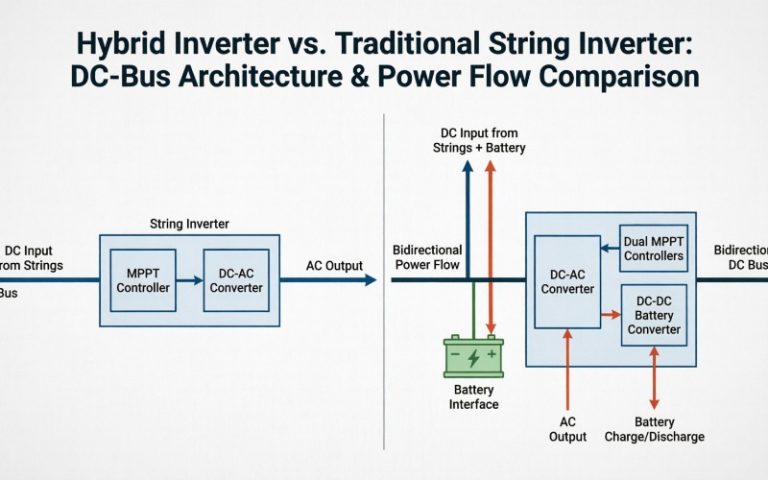
Technically, a PCS is much more than a standard solar inverter. It must support four-quadrant operation, meaning it can manage both active power (P) and reactive power (Q) simultaneously. For utility-scale applications, Moneypro Energy utilizes 3-level NPC (Neutral Point Clamped) topologies using Infineon IGBT modules to ensure a THDi (Total Harmonic Distortion) of less than 3%, which is critical for meeting IEEE 1547 and UL 1741 SB standards.
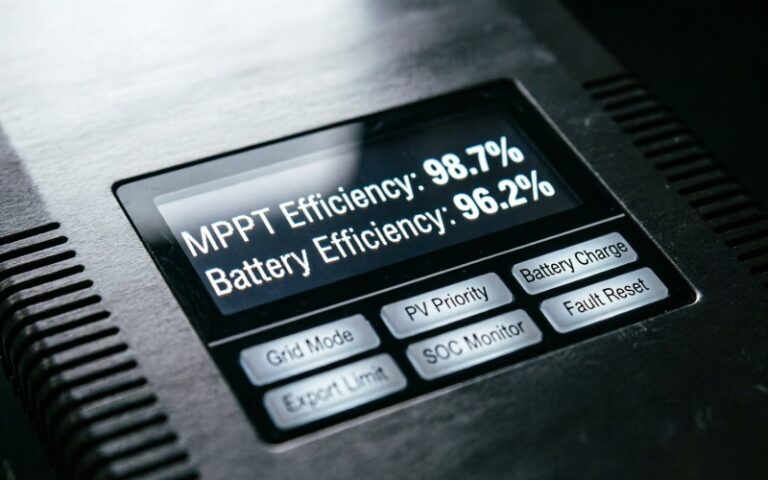
Efficiency is the primary KPI here. While many providers settle for 97%, our factory-direct PCS units leverage advanced PWM (Pulse Width Modulation) algorithms to achieve 99% peak efficiency. This reduction in heat dissipation not only lowers the thermal load on the container’s HVAC system but also significantly improves the Levelized Cost of Storage (LCOS) by reducing conversion losses over thousands of cycles. Key features like black-start capability and grid-forming technology allow our PCS to support remote microgrids where no external voltage reference is present.
Why is the Battery Management System (BMS) the Gateway to Functional Safety?
The Battery Management System (BMS) acts as the primary safety layer, continuously monitoring cell-level voltage, current, and temperature to prevent thermal runaway and ensure LFP battery longevity.
A professional-grade BMS follows a three-tier architecture: the Battery Management Unit (BMU) for individual module monitoring, the Cluster Battery Management System (CBMS) for string-level control, and the General Battery Management System (GBMS) for total system oversight. At Moneypro Energy, we implement active balancing rather than cheaper passive balancing. This allows energy to be transferred from higher-voltage cells to lower-voltage ones, rather than just wasting excess energy as heat, effectively increasing the usable capacity of the battery pack by 3-5%.
From an O&M perspective, the BMS provides the vital SOX data (State of Charge, State of Health, State of Power). We utilize high-precision ADC (Analog-to-Digital Converters) and Japanese-made capacitors to ensure that SOC estimation errors remain under 2%. This precision is vital for large-scale Solar Farm Energy Storage, where inaccurate SOC readings can lead to premature system shutdowns or, worse, over-discharge that permanently damages the LFP chemistry. Our BMS is also programmed with a multi-level protection logic that communicates directly with the DC contactors and the PCS via high-speed CAN 2.0B protocol.

When Does the Energy Management System (EMS) Become the Project’s Brain?
The Energy Management System (EMS) is the software-driven intelligence layer that determines ‘when’ and ‘how much’ energy to move based on market prices, load profiles, and renewable generation forecasts.
While the BMS and PCS are localized hardware controllers, the EMS is often a cloud-integrated SCADA system. It is the component that interacts with the end-user’s HMI or a utility’s dispatch center. For Commercial Building Energy Storage, the EMS runs complex peak-shaving algorithms, identifying the precise moment to discharge the battery to avoid high demand charges from the utility provider.
Moneypro Energy’s EMS supports advanced protocols like OpenADR and IEEE 2030.5, enabling our clients to participate in Virtual Power Plants (VPP) and frequency regulation markets. It gathers weather data, historical load patterns, and real-time energy pricing to create a 24-hour predictive dispatch model. Without a robust EMS, a BESS is just a giant battery; with it, the system becomes a dynamic financial asset capable of generating revenue through grid services and TOU (Time-of-Use) arbitrage.
PCS vs BMS vs EMS: A Technical Comparison for System Integrators
| Feature | PCS (Power Conversion) | BMS (Battery Management) | EMS (Energy Management) |
|---|---|---|---|
| Primary Role | Energy Conversion (AC/DC) | Safety & Cell Monitoring | Logic & Economic Dispatch |
| Core Hardware | IGBTs, Transformers, Filters | Sensors, MCUs, Contactors | Industrial PC, Cloud Servers |
| Key Metrics | Efficiency, THDi, PF Range | SOC, SOH, Cell Temperature | ROI, Peak Shaving Ratio, Yield |
| Communication | Modbus RTU, CAN, Ethernet | CANbus, RS485 | Modbus TCP, API, OpenADR |
| Safety Function | Anti-islanding, Overcurrent | Overvoltage, Thermal Runaway | System-wide Emergency Stop |
How to Choose the Right BESS Components for Factory Energy Storage
Selecting components for Factory Energy Storage requires a heavy focus on the PCS’s surge capacity for inductive loads and the EMS’s ability to integrate with existing Building Management Systems (BMS).
Industrial environments often have high-start-up currents from motors and machinery. A robust PCS must be sized to handle these transients without tripping. Furthermore, the integration between the BMS and the factory’s fire suppression system is mandatory for insurance compliance. At Moneypro Energy, we provide pre-configured containers where the PCS and BMS are already synchronized to a local EMS controller, reducing on-site commissioning time by up to 40%.
By sourcing factory-direct from Moneypro Energy, integrators gain access to our engineering team who can customize the EMS firmware for specific industrial applications, such as Data Center Energy Storage where sub-10ms UPS-grade switching is required. Our hardware undergoes 48-hour high-temperature aging tests at our manufacturing facility to ensure that when it reaches your site, it is ready for the rigors of 24/7 operation.
Frequently Asked Questions
Can the PCS operate without a BMS?
No. For safety reasons, the PCS requires a ‘Heartbeat’ and SOX data from the BMS via a communication link (usually CAN or Modbus). If the BMS detects a critical fault, it will open the DC contactors and signal the PCS to stop conversion immediately to prevent damage or fire.
What is the difference between Local EMS and Cloud EMS?
A Local EMS is an industrial-grade controller installed on-site for real-time control and zero-latency decision making. A Cloud EMS provides higher-level data aggregation, fleet management, and complex economic modeling. Most modern BESS, including those from Moneypro Energy, use a hybrid approach.
Is LFP the only chemistry supported by your BMS?
While our standard systems are optimized for Lithium Iron Phosphate (LFP) due to its safety and cycle life, our BMS architecture is flexible and can be calibrated for NMC or even Sodium-ion (Na-ion) chemistries depending on the project requirements.
Transform Your Energy Infrastructure with Moneypro Energy
Wholesale & Distribution: Looking to carry high-reliability PCS and BMS hardware? Contact our sales team for bulk pricing and regional exclusivity opportunities.
System Integrators: Need a custom EMS logic for a specific C&I project? Our R&D department provides full SDK support and white-label firmware options.
Get a Final RFQ: Ready to move forward? Submit your project specs today for a comprehensive technical proposal and BOM within 48 hours. [Contact Our Engineering Team]