What Is the Role of Hybrid Inverters in Modern Energy Storage?
Executive Summary: Hybrid inverters serve as the centralized intelligence for modern Energy Storage Systems (ESS), bridging DC-coupled storage with AC grid requirements. They facilitate seamless energy arbitrage, grid stabilization, and backup power, providing utility-grade reliability and high ROI for large-scale and commercial energy projects globally.
Table of Content:
- Defining the Hybrid Brain of Modern ESS
- Technical Architecture and Bi-directional Conversion
- Grid-Forming vs. Grid-Following Capabilities
- Commercial ROI: Peak Shaving and VPP Readiness
- Manufacturing Excellence: Factory-Level Quality Controls
- Technical Comparison Table
- Frequently Asked Questions
- The Future of Energy Management
Key Takeaways for Utility Managers
- Unified Power Conversion: Hybrid inverters consolidate PV, battery, and grid management, reducing BoS (Balance of System) costs by 15-20%.
- Sub-10ms Switching: High-speed switching ensures UPS-grade reliability for critical C&I loads, surpassing traditional string inverter capabilities.
- VPP Integration: Built-in Modbus and SunSpec protocols allow seamless integration into Virtual Power Plants, similar to deployments by Sungrow and SMA.
- Industrial Durability: Tier-1 components like Infineon IGBTs and Japanese capacitors ensure a 25-year design life under harsh conditions.
Defining the Hybrid Brain of Modern ESS
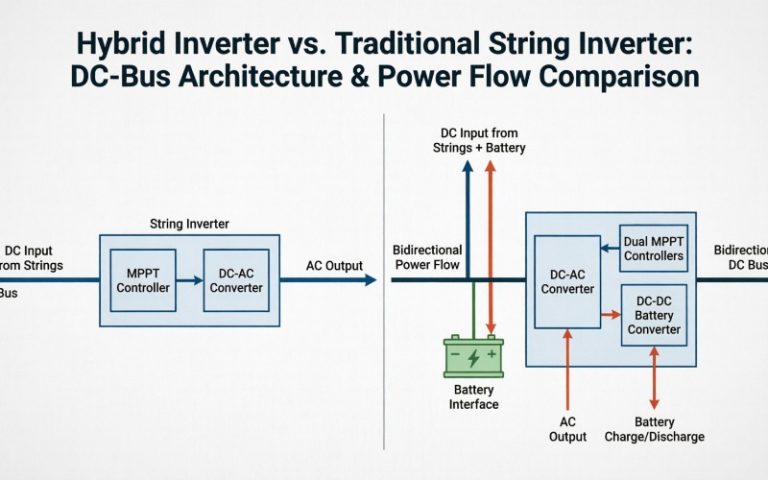
The hybrid inverter is a multi-mode power conversion system (PCS) that simultaneously manages inputs from photovoltaic (PV) arrays and battery storage while synchronizing with the utility grid or operating in islanded mode.
In the evolving landscape of renewable energy, the transition from simple grid-tie systems to complex, multi-source microgrids has necessitated a more sophisticated approach to power electronics. Unlike traditional string inverters that only convert DC from solar panels to AC for the grid, the hybrid inverter—often referred to as a multi-mode inverter—functions as the central dispatcher of energy. It must intelligently decide whether to send PV energy to the loads, store it in a Lithium Iron Phosphate (LFP) battery bank, or export it to the grid based on real-time pricing and load demand.
For utility project managers and energy consultants, the choice of a hybrid inverter is not merely a component selection but a strategic decision impacting long-term system bankability. As global standards move toward UL 1741 SB and IEEE 1547-2018, the ability of these units to provide reactive power support and frequency regulation becomes paramount. Industry leaders like GoodWe and Solis have paved the way for high-voltage hybrid architectures, but factory-direct innovation is now pushing the boundaries with higher C-rates and integrated EMS (Energy Management Systems).
Technical Architecture and Bi-directional Conversion
Modern hybrid inverters utilize advanced bi-directional DC-DC and DC-AC conversion stages to maintain a Total Harmonic Distortion (THDi) of less than 3% while managing high-current battery discharges.
Dual MPPT Optimization and Oversizing
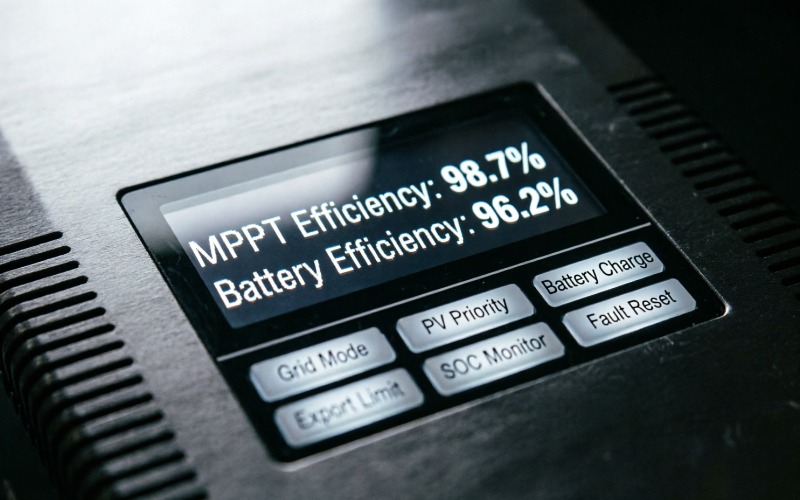
Efficiency starts at the source. Professional-grade hybrid inverters feature multiple Maximum Power Point Tracking (MPPT) channels with wide voltage ranges (typically 150V – 850V for C&I units). This allows for complex rooftop orientations and varying string lengths. Furthermore, a high PV-to-AC ratio (often 150% or more) enables the system to capture excess energy during peak solar hours, which is then diverted to the DC-coupled battery storage rather than being clipped, significantly increasing the overall system yield.
Thermal Management and Reliability
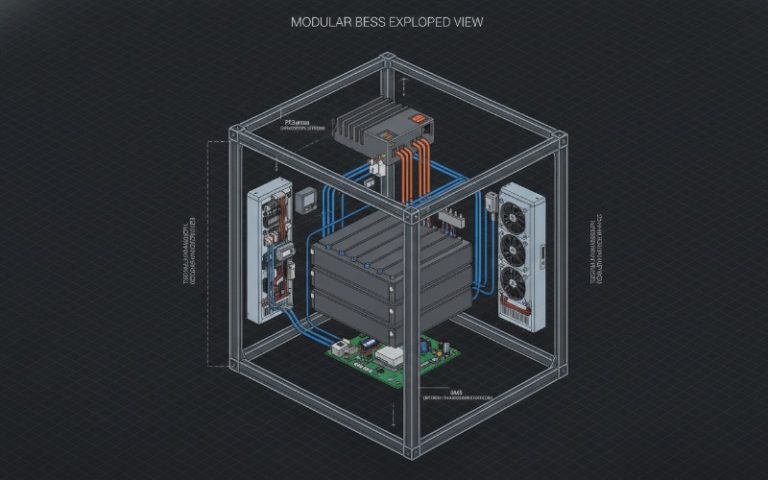
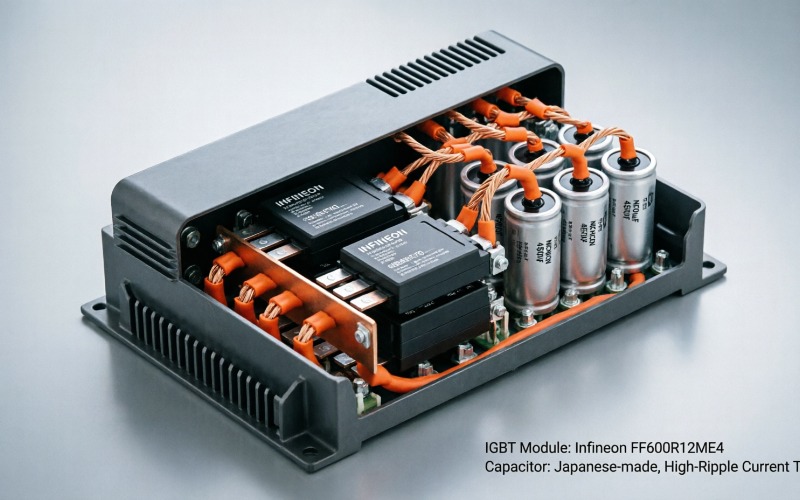
At the heart of our manufacturing process is a focus on thermal dynamics. High-power conversion generates significant heat, particularly in the IGBT (Insulated Gate Bipolar Transistor) modules. By utilizing Infineon or ON Semiconductor power modules and combining them with redundant cooling systems (active fan cooling with IP66 protection), we ensure that the inverter can operate at full rated power in ambient temperatures up to 45°C without derating. This is a critical factor for Utility projects in regions like the Middle East or Australia where thermal performance dictates the lifetime ROI.
Grid-Forming vs. Grid-Following Capabilities
Grid-forming hybrid inverters act as a voltage source, capable of establishing an autonomous microgrid frequency and voltage during a total grid failure, unlike standard grid-following inverters.
For energy consultants designing resilient infrastructure, the ‘Black Start’ capability is non-negotiable. During a grid outage, a standard solar inverter will shut down to prevent islanding (an anti-islanding safety requirement). However, a sophisticated hybrid solar inverter with grid-forming capability uses its internal battery reserve to create a reference signal, allowing the microgrid to remain operational. This involves complex algorithms that manage transient loads and inrush currents from heavy machinery or HVAC systems, often requiring a surge capacity of 200% for short durations (up to 10 seconds).
This functionality aligns our technology with high-end solutions from Tesla Powerwall or Victron Energy, but at a scale suitable for commercial three-phase applications. By integrating high-speed Digital Signal Processors (DSPs), our inverters can detect a grid failure and transition to backup mode in less than 10 milliseconds—effectively providing an Uninterruptible Power Supply (UPS) for industrial operations.
Commercial ROI: Peak Shaving and VPP Readiness
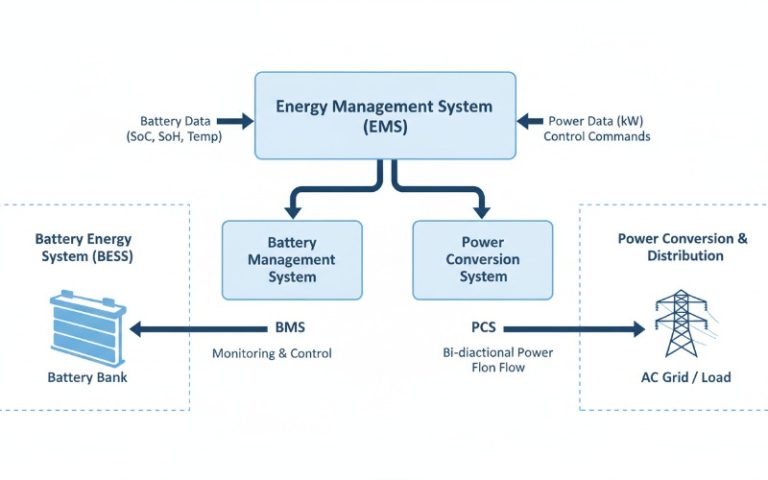
The primary commercial driver for hybrid inverters in the C&I sector is the reduction of demand charges through peak shaving and the generation of new revenue streams via VPP participation.
In many jurisdictions, commercial electricity bills are split between consumption (kWh) and peak demand (kW). A hybrid inverter, coupled with an intelligent EMS, can monitor the building’s load in real-time. When the load approaches a pre-set threshold, the inverter discharges the battery to ‘shave’ the peak, potentially saving thousands of dollars in monthly demand charges. This application is particularly effective in manufacturing facilities where heavy motor starts create massive, expensive spikes in demand.
Furthermore, as we look toward 2026, the role of hybrid inverters extends to the Virtual Power Plant (VPP) ecosystem. By utilizing standardized communication protocols (Modbus TCP/RTU, CAN, and SunSpec), our inverters can be controlled remotely by a utility aggregator to provide frequency response or spinning reserves. This turns a static energy asset into a dynamic participant in the energy market, accelerating the payback period for large-scale distributors and project owners.
Manufacturing Excellence: Factory-Level Quality Controls
Achieving 98.4% peak efficiency and a 10-year standard warranty requires rigorous component selection and a multi-stage stress-testing protocol at the factory level.
As an integrated manufacturer, we do not simply assemble parts. Our R&D team focuses on the intersection of power electronics and chemical stability. For instance, we specify Japanese-made Nippon Chemi-Con capacitors which offer significantly higher ripple current ratings and longer lifespans than generic alternatives. Every hybrid inverter that leaves our facility undergoes a 48-hour full-load high-temperature aging test (at 50°C) to identify and eliminate ‘infant mortality’ failures in the semiconductor sets.
Our production line is ISO 9001 and ISO 14001 certified, ensuring that every weld on the PCB and every torque setting on the busbars is logged and traceable. For OEM clients, this means a significantly lower O&M (Operations and Maintenance) burden and fewer field replacements, which are the hidden killers of project profitability. When compared to low-cost competitors, the technical depth of our assembly—using automatic optical inspection (AOI) and X-ray testing for BGA components—ensures a failure rate of less than 0.5% over the first five years.
Technical Comparison Table
| Feature | Standard String Inverter | Hybrid Inverter (C&I Grade) | Off-Grid Inverter |
|---|---|---|---|
| Grid Integration | Grid-Following Only | Grid-Following & Grid-Forming | Independent/Islanded |
| Battery Support | None (Requires AC Coupling) | Direct DC Coupling (High Voltage) | Required |
| Switching Time | N/A | < 10ms (UPS Grade) | Instantaneous |
| Efficiency (Max) | 98.0% – 99.0% | 97.5% – 98.4% | 93.0% – 95.0% |
| Communication | Basic Monitoring | SunSpec, Modbus, VPP Ready | Proprietary/Basic |
| Primary Use Case | Utility Scale Solar Farms | Commercial ESS, Backup, ROI | Remote Sites, Telecom |
Frequently Asked Questions
What is the difference between AC-coupled and DC-coupled hybrid systems?
Can your hybrid inverters handle unbalanced three-phase loads?
What safety certifications are standard for your hybrid products?
The Future of Energy Management
The role of hybrid inverters in modern energy storage is no longer just about conversion; it is about intelligent orchestration. As the grid becomes increasingly decentralized, the hardware at the edge must be more capable, more reliable, and more connected. Our factory-direct solutions are engineered to meet these demands, offering the R&D depth and manufacturing scale needed to power the next generation of global energy infrastructure.
Ready to Elevate Your Energy Portfolio?
Contact our engineering team today for a comprehensive RFQ and technical consultation for your next utility project.