Top 5 Countries With the Largest Solar Farms (2026 Global Ranking)
☀️ Energy intelligence from China MoneyPro Energy – advanced power solutions
☀️ Quick Answer: Which country has the largest solar farm in 2026?
China dominates the global solar landscape. The country is home to the world’s largest solar farms, including the Gonghe / Talatan Solar Park in Qinghai province, which has surpassed 15,600 MW and is still expanding. The Midong Solar Project in Xinjiang is the largest single-site solar plant at 3,500 MW . India follows with the Bhadla Solar Park (2,245 MW), and the UAE’s Al Dhafra (2,000 MW) is one of the largest single-site plants. However, a new challenger – the Meralco Terra Solar Project in the Philippines – aims to deliver 3,500 MW of solar power and 4,500 MWh of storage, making it the world’s largest integrated solar and battery storage facility once fully complete in 2027 .
📑 Contents
What Defines a “Large” Solar Farm?Top 5 Countries by Largest Solar FarmsComparison TablePros & ConsBuying GuideFAQ
Global large-scale solar capacity surpassed 1 TWac in 2025, with China leading the charge at 446 GWac – more than the US and India combined . The race for the world’s largest solar farm is a constantly shifting landscape, with new megaprojects coming online every year.
From our experience at China MoneyPro Energy, where we develop advanced energy storage systems and intelligent power solutions, we’ve seen firsthand how these giant solar farms are reshaping global energy markets. In this guide, we rank the top 5 countries with the largest solar farms and explain what these projects mean for the future of energy.
For energy storage solutions that support large-scale solar, see our Battery Management System guide.
What Defines a “Large” Solar Farm?
When we talk about the “largest” solar farms, we’re typically referring to installed capacity in megawatts (MW) or gigawatts (GW). However, there’s a distinction between:
- Single-site solar plants – A single contiguous installation (e.g., Midong at 3.5 GW).
- Solar parks or complexes – Multiple plants in the same region, often built in phases (e.g., Gonghe/Talatan at 15.6 GW).
- Integrated solar + storage – Projects combining solar with battery storage (e.g., MTerra Solar in the Philippines).
Who Should Care About Solar Farm Rankings?
- Energy investors – To identify growth markets and technological trends.
- Policy makers – To benchmark national progress against competitors.
- Commercial users – Businesses looking to procure solar power or enter the renewable energy market.
Who does not need to care? If you’re a residential consumer, the largest farms don’t directly affect you – but they do signal the direction of the energy transition.
For renewable energy equipment, see our floating PV system solutions.
Top 5 Countries by Largest Solar Farms
1 China – The Undisputed Leader
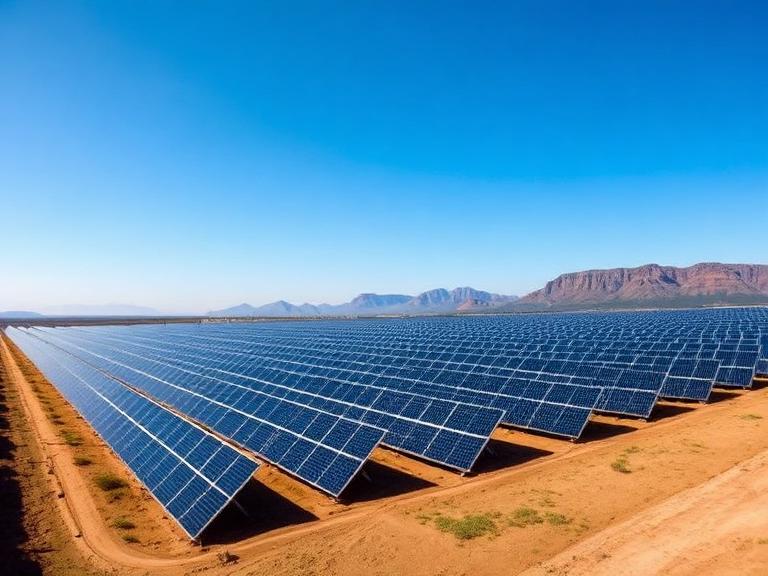
China is the world’s largest solar market by a massive margin, with 446 GWac of utility-scale capacity and over 5,600 projects . The country’s dominance is driven by state-backed investment, vast desert land, and a relentless pace of construction.
- Gonghe / Talatan Solar Park (Qinghai) – At 15,600 MW (and expanding), this complex is the largest solar facility in the world. Spanning 420 square kilometers (seven times the size of Manhattan), it combines solar, wind, and hydropower to create a renewable energy hub .
- Midong Solar Project (Xinjiang) – The largest single-site solar plant globally, with 3.5 GW of capacity. It covers 200,000 acres of desert and generates enough power for three million homes .
- Huanghe Solar Park (Qinghai) – 2.2 GW of operating capacity, part of larger solar-hydro complementary schemes .
2 India – The Thar Desert Powerhouse
India ranks third globally in large-scale solar capacity (109.6 GWac) . The country’s largest installations are concentrated in the Thar Desert, where land is abundant and sunlight is intense.
- Bhadla Solar Park (Rajasthan) – 2,245 MW, fully commissioned by 2020. It spans 56 km² and is one of the world’s largest solar parks .
- Pavagada Solar Park (Karnataka) – 2,050 MW, commissioned by 2019 .
3 United States – The Western Solar Boom
The US ranks second globally with 162.8 GWac of utility-scale capacity . While the country lacks a single mega-complex comparable to Gonghe, it has numerous large-scale installations across California, Texas, and the Southwest.
- Top US projects: The US is home to projects like the Gemini Solar Project (Nevada) and numerous installations in California’s Mojave Desert.
4 UAE – The Desert Giant
The United Arab Emirates has made a significant mark with the Al Dhafra Solar PV Plant in Abu Dhabi, which achieved 2.0 GW of capacity in June 2023. It is widely billed as the largest single-site solar PV plant in the world .
5 Philippines – The New Contender
The Meralco Terra (MTerra) Solar Project in Nueva Ecija is set to become the world’s largest integrated solar and battery storage facility. Phase I is 91% complete and expected to be commercially operational by August 2026. Once both phases are completed, it will deliver 3,500 MW of solar power and 4,500 MWh of battery storage, powering over 2.4 million households .
For energy storage integration, explore our Power Conversion System solutions.
Comparison Table: Top 5 Countries by Largest Solar Farms
| Country | Largest Solar Facility | Capacity (MW) | Type | Status |
|---|---|---|---|---|
| China | Gonghe / Talatan Solar Park | 15,600+ | Complex (multi-project) | Operating & expanding |
| China | Midong Solar Project | 3,500 | Single-site | Operating |
| India | Bhadla Solar Park | 2,245 | Solar park | Operating |
| UAE | Al Dhafra Solar PV | 2,000 | Single-site | Operating |
| Philippines | Meralco Terra Solar | 3,500 (solar) | Solar + storage | Phase I 2026, full 2027 |
Pros & Cons of Mega Solar Farms
- Economies of scale – Larger farms lower the cost per MW.
- Grid stability – Integrated storage (like MTerra) smooths power output.
- Job creation – Large projects create thousands of construction and operational jobs.
- Carbon reduction – MTerra is expected to reduce 4.3 million metric tons of CO₂ annually .
- Energy security – Reduces reliance on imported fossil fuels.
- Land use – Solar farms require vast tracts of land, often in ecologically sensitive areas.
- Transmission costs – Remote locations require expensive transmission infrastructure.
- Intermittency – Solar power is not available at night without storage.
- Water use – Dust cleaning can be water-intensive in desert regions.
Buying Guide: How to Choose a Solar Farm Partner
If you’re looking to invest in or develop a large-scale solar project, here’s a practical checklist based on our industry experience.
Site Selection – Land availability, solar irradiation, and proximity to grid connections are critical. China’s success comes from utilising vast desert and plateau regions .
Technology Choice – Bifacial panels (as used in Midong) and trackers can significantly boost yield .
Storage Integration – Battery storage (like the 4,500 MWh system at MTerra) is becoming essential for grid stability and arbitrage .
Regulatory Environment – Government support, feed-in tariffs, and permitting timelines vary by country.
Financing – Large solar projects often require a mix of equity, debt, and government support.
EPC Partner – Choose an experienced engineering, procurement, and construction partner.
For EV charging infrastructure to complement solar farms, see our AC EV Charger solutions.
Our Expert Recommendation: Where to Focus Your Solar Investment
Based on our analysis of the global solar landscape, here is our recommended focus for different investor profiles:
- For large-scale developers: China remains the dominant market, but the Philippines (MTerra) and the Middle East (UAE, Saudi Arabia) offer emerging opportunities .
- For technology providers: Energy storage is the next frontier. Projects like MTerra, with 4,500 MWh of storage, are setting the standard for integrated solar + storage systems .
- For investors: Look for markets with clear regulatory frameworks and strong government support.
For backup power solutions in remote solar installations, see our ICT Backup Power Systems.
Common Mistakes When Evaluating Solar Farms
- Confusing “capacity” with “generation” – A 3.5 GW solar farm doesn’t generate 3.5 GW continuously. Capacity factor is typically 20–30%.
- Ignoring storage integration – Solar without storage is increasingly risky in markets with high solar penetration.
- Overlooking transmission constraints – Even the largest solar farm is useless without a grid connection.
- Not accounting for degradation – Solar panels degrade at 0.5–1% per year. This must be factored into financial models.
About China MoneyPro Energy – China MoneyPro Energy is a technology-driven developer of advanced energy storage systems and intelligent power solutions, built upon a strong heritage of national-level research institutes and decades of engineering experience in high-reliability systems. We support the renewable energy transition with integrated energy storage, EV charging, and industrial power solutions.
Frequently Asked Questions
Which country has the largest solar farm in the world?
China has the largest solar farms, including the Gonghe/Talatan complex (15,600+ MW) and the Midong single-site plant (3,500 MW) .
What is the largest single-site solar farm?
The Midong Solar Project in Xinjiang, China, at 3,500 MW, is currently the largest single-site solar farm .
Is the Philippines building a new solar farm?
Yes – the Meralco Terra Solar Project in Nueva Ecija is set to be the world’s largest integrated solar and battery storage facility, with 3,500 MW of solar and 4,500 MWh of storage .
Which country has the most large-scale solar capacity?
China leads with 446 GWac of utility-scale solar capacity, far ahead of the US (162.8 GWac) and India (109.6 GWac) .
📚 References & Trusted Sources
- 1. Philippine Information Agency – President Marcos inaugurates world’s largest solar farm
- 2. pv magazine Australia – Large-scale solar surpasses 1 TWac worldwide
- 3. Interesting Engineering – World’s 10 biggest solar power projects
- 4. Wiki-Solar – Global Large-Scale Solar Database
- 5. POWER Magazine – Midong Solar Project
Explore more: Lithium Battery Pack | BOS Components | Monitoring & Communication | DC Fast Charger | Wind Power Products