LFP vs. NMC: Choosing the Right Energy Storage System Type
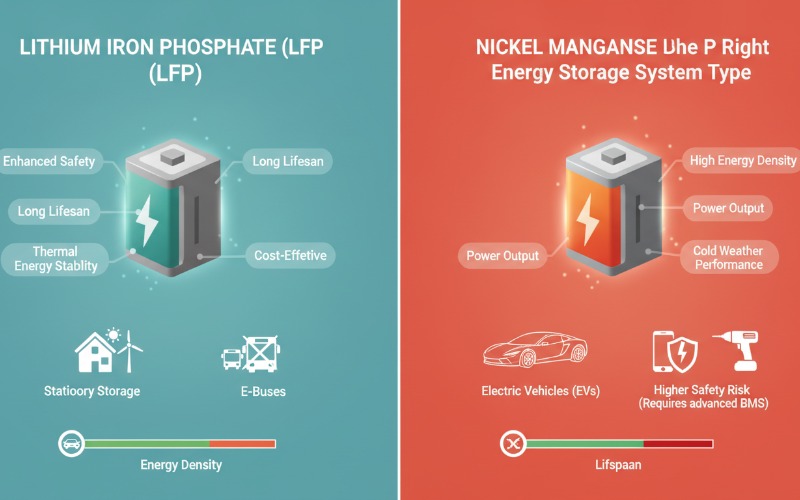
Executive Summary: For B2B system integrators and utility-scale developers, selecting the optimal energy storage chemistry is a balance of thermal stability, cycle longevity, and capital expenditure. While NMC offers higher energy density, LFP has emerged as the industry standard for stationary storage due to its superior safety profile and lower LCOS.
Key Takeaways for System Integrators
- LFP Supremacy: Lithium Iron Phosphate (LFP) is the preferred choice for 90% of C&I and Utility-scale projects due to its 6,000+ cycle life at 0.5C/0.5C.
- NMC Use-Cases: Nickel Manganese Cobalt (NMC) remains relevant only in space-constrained urban environments where volumetric energy density is the primary constraint.
- Safety Metrics: LFP exhibits a thermal runaway threshold of ~270°C, compared to ~210°C for NMC, significantly reducing fire suppression costs.
- Economic ROI: Despite a slightly higher initial footprint, LFP provides a 30-40% lower Levelized Cost of Storage (LCOS) over a 10-15 year project lifespan.
Table of Contents
- The Fundamental Chemistry: LFP vs. NMC vs. Lead-Acid
- Thermal Stability and Fire Safety Protocols
- Cycle Life and Degradation: Long-Term ROI Analysis
- Manufacturing Excellence: How Moneypro Energy Optimizes LFP Systems
- Technical Specification Comparison
- Application-Specific Selection Guide
- Frequently Asked Questions
Why Does Battery Chemistry Dictate Your Energy Storage System Strategy?
The choice between LFP and NMC determines the fundamental operating parameters of your BESS, including C-rate capability, thermal management overhead, and insurance premiums.
In the evolving landscape of 2026, the global energy storage market has bifurcated into two primary lithium-ion technologies: Lithium Iron Phosphate (LiFePO4 or LFP) and Nickel Manganese Cobalt (LiNiMnCoO2 or NMC). Historically, NMC dominated due to its high specific energy, which was critical for the EV sector where weight is a penalty. However, for stationary applications like Commercial Building Energy Storage, weight is secondary to cycle life and safety.
LFP utilizes an olivine crystal structure which is inherently more stable. The P-O bond in the (PO4)3- unit is stronger than the Co-O bond in NMC, meaning LFP does not release oxygen during high-temperature events. This chemical reality is why industry giants like Sungrow and GoodWe have pivoted almost exclusively to LFP for their utility-scale PowerTitan and Lynx series. At Moneypro Energy, we utilize Tier 1 LFP cells with high-purity electrolytes to ensure THDi <3% and maximum round-trip efficiency (RTE) exceeding 95%.
How Does Thermal Stability Impact Utility-Scale Risk Management?
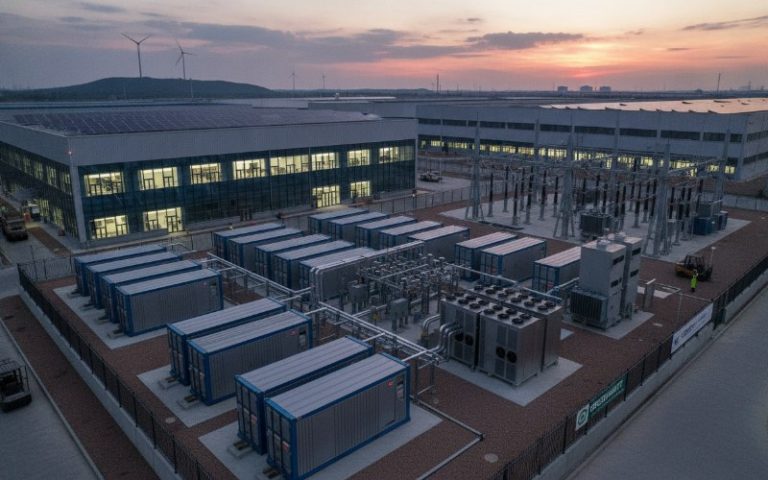
LFP systems exhibit a significantly higher thermal runaway temperature, allowing for simplified HVAC design and lower fire suppression costs in high-density installations.
Safety is the non-negotiable cornerstone for B2B clients. NMC batteries are prone to “oxygen release” at high temperatures, which can lead to self-sustaining fires that are notoriously difficult to extinguish. In contrast, LFP’s thermal runaway occurs at higher temperatures and does not involve the release of oxygen, significantly reducing the risk of fire propagation. This makes LFP the only viable choice for Data Center Energy Storage where uptime and hazard mitigation are paramount.
Moneypro Energy takes this a step further. Our rack-level BMS integrates triple-layer protection—software, hardware, and chemical—monitoring cell voltages at millisecond intervals. By using Japanese-sourced Nippon Chemi-Con capacitors and Infineon IGBTs in our PCS, we minimize heat generation at the power conversion stage, ensuring the system operates well within the safe thermal envelope even during 1C peak-shaving operations. This engineering rigor ensures compliance with UL 9540A and NFPA 855 standards.
Cycle Life and Degradation: The Math Behind 6,000+ Cycles
Standard LFP cells offer a service life of 6,000 to 8,000 cycles at 80% Depth of Discharge (DOD), whereas NMC typically degrades to 80% SoH after only 2,000 to 3,000 cycles.
For an IPP (Independent Power Producer) managing a Solar Farm Energy Storage project, the Levelized Cost of Storage (LCOS) is the king of metrics. If your battery fails after 7 years, your ROI collapses. LFP’s robust chemical bonds allow it to withstand daily cycling—charging during solar peak and discharging during evening peak—for over 15 years. NMC’s degradation curve is much steeper, particularly when exposed to high ambient temperatures or high C-rates.
Our internal testing at Moneypro Energy involves a 48-hour high-temperature aging test for every module. We guarantee an 80% State of Health (SoH) after 10 years for our standard C&I product line. This longevity is supported by our active balancing BMS algorithms, which prevent over-voltage and under-voltage conditions that typically accelerate lithium plating. By comparing our data with industry benchmarks from CATL or BYD, our systems provide a competitive edge in long-term reliability.
Manufacturing Excellence: The Moneypro Factory Direct Advantage
By controlling the entire supply chain from cell procurement to PCS manufacturing, Moneypro Energy delivers 15-20% higher cost-efficiency than traditional integrators.
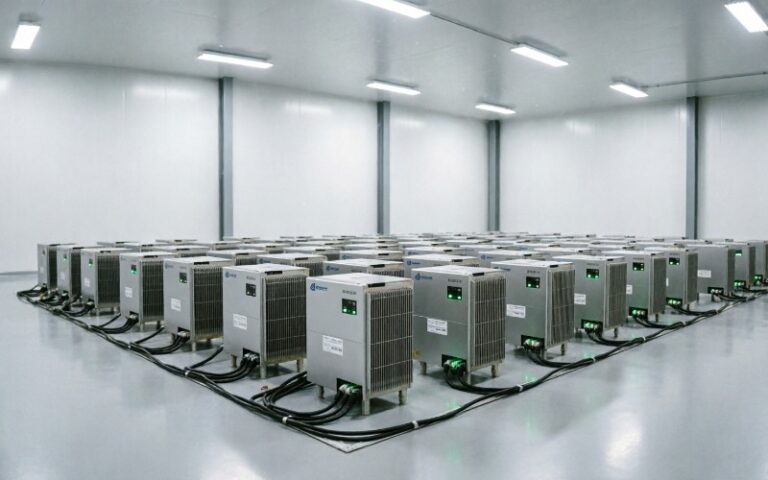
Unlike “white-label” brands, Moneypro Energy is a true factory. Our production line features automated cell sorting, laser welding, and comprehensive End-of-Line (EOL) testing. We don’t just assemble; we innovate at the firmware level. Our EMS (Energy Management System) supports advanced VPP (Virtual Power Plant) protocols and seamless integration with grid stabilization services.
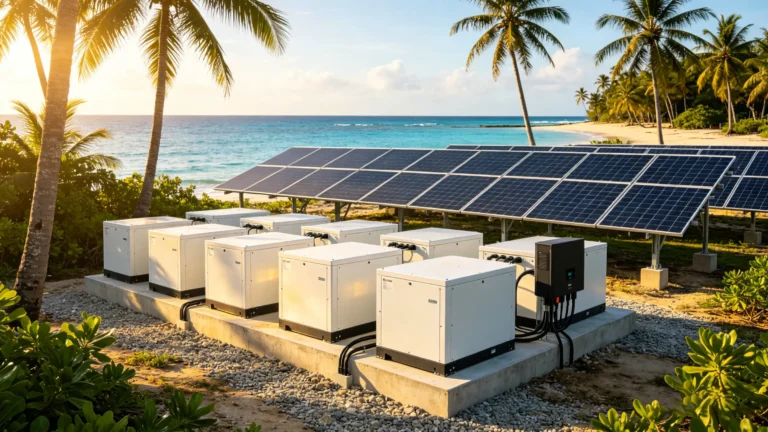
When you source from us, you are not just buying a battery; you are buying an engineered solution. Our LFP packs are housed in IP66-rated enclosures, making them suitable for harsh environments from desert solar farms to coastal Remote Power Systems. We utilize high-efficiency MPPT controllers and modular PCS designs that allow for easy hot-swapping and maintenance, reducing O&M costs over the life of the asset.
Technical Comparison: LFP vs. NMC for Industrial ESS
| Feature | Lithium Iron Phosphate (LFP) | Nickel Manganese Cobalt (NMC) |
|---|---|---|
| Specific Energy (Wh/kg) | 90 – 160 | 150 – 250 |
| Cycle Life (80% DOD) | 6,000 – 10,000 | 2,000 – 3,500 |
| Thermal Runaway Temp | ~270°C (Stable) | ~210°C (Unstable) |
| Up to 100% (Recommended 90%) | Up to 90% (Recommended 80%) | |
| Raw Material Concerns | Low (No Cobalt/Nickel) | High (Ethical Cobalt sourcing) |
| Typical B2B Application | Utility, C&I, Microgrids | EVs, Space-limited Residential |
Where Should You Deploy These Systems?
The decision matrix for a B2B project should focus on application requirements. For Factory Energy Storage, where peak-shaving and backup power are the primary drivers, LFP is the undisputed winner. Its ability to handle high power bursts without significant degradation makes it ideal for starting large industrial motors.
However, if you are working on a Residential Solar Storage project in a high-rent city like Tokyo or London where space is at an absolute premium, a high-density NMC system might be considered. But even then, the trend is shifting toward LFP due to stricter local fire regulations. For Grid Stabilization projects, the fast response time and high cycle count of LFP provide the necessary reliability for frequency regulation services.
Frequently Asked Questions
Is LFP really cheaper than NMC for industrial projects?
While the initial CapEx per kWh is now comparable, LFP’s total cost of ownership is significantly lower. Because LFP lasts 2-3 times longer than NMC, you avoid the massive expense of “battery augmentation” or full replacement halfway through a 20-year PPA (Power Purchase Agreement).
Can LFP batteries operate in extreme cold?
LFP batteries traditionally perform worse in sub-zero temperatures compared to NMC. However, Moneypro Energy integrates advanced thermal management systems and internal heating mats that allow our systems to discharge at full capacity even at -20°C, making them suitable for high-latitude installations.
What certifications should I look for in an ESS factory?
For global B2B distribution, ensure the factory holds UL 1973 (for battery packs), UL 1741 SB (for inverters/PCS), and IEC 62619. Moneypro Energy products are fully certified for the US, EU, and Australian markets, ensuring a smooth interconnection process with local utilities.
Ready to Power Your Next Project?
Wholesale & Distribution: Looking to become a regional distributor for Moneypro Energy? We offer tiered pricing and priority technical support for high-volume partners. Get a Wholesale Quote.
Custom OEM/ODM Solutions: Need a bespoke battery pack or a branded containerized ESS? Our R&D team can take your specs from concept to mass production. Start Your Custom Project.
Technical RFQ: Submit your project requirements today, and our engineers will provide a comprehensive system simulation and ROI analysis within 48 hours. Submit RFQ Now.