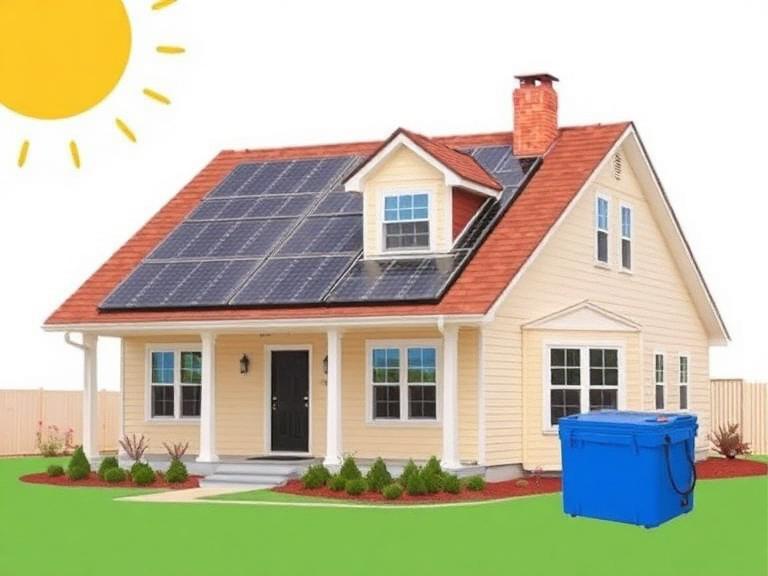
How Much Do Solar Panels Cost for a 2000 Square Foot House with a Battery?
If you are a homeowner stepping into the renewable energy market in 2026, the single most critical question on your mind is likely related to the exact solar panels cost for a 2000 square foot home. However, the energy landscape has fundamentally shifted. From our experience, quoting a solar system without including a robust battery backup is a massive disservice. Without energy storage, you are merely renting grid access during the day and paying premium utility rates at night. We recommend that every modern solar installation include an intelligent battery system to guarantee true energy independence.
Determining the real solar panels cost for a 2000 square foot property requires looking past simple square footage. Your actual electricity consumption, the orientation of your roof, and the specific equipment you choose dictate the final price. When clients ask us to calculate the solar panels cost for a 2000 square foot house, we remind them that a highly efficient home will require vastly different equipment than a home running multiple air conditioning units and electric vehicles.
In this authoritative guide, we will break down the precise figures, expose industry pricing myths, and provide you with an unfiltered look at the solar panels cost for a 2000 square foot residence equipped with lithium battery storage.
Table of Contents
- Why You Absolutely Must Include a Battery in 2026
- Sizing Your System: Beyond Square Footage
- Breaking Down the Solar Panels Cost for a 2000 Square Foot Home
- Summary Table: Estimated Total Costs
- Integrating EV Charging into Your Solar Ecosystem
- The Role of Advanced Monitoring and Industrial Tech
- About China MoneyPro Energy
- Expert Advice: Avoiding the Race to the Bottom
- Frequently Asked Questions (FAQs)
- Industry References
Why You Absolutely Must Include a Battery in 2026
Let us be perfectly candid: installing solar panels without energy storage is an outdated practice. Across the United States and globally, utility companies are systematically dismantling favorable net metering policies (such as NEM 3.0 in California). This means they are paying you mere pennies for the excess solar power you export during the day, while charging you exorbitant Time-of-Use (TOU) rates in the evening.
By adding a 10 kWh to 15 kWh lithium iron phosphate (LiFePO4) battery to your setup, you store the energy you generate during the day and consume it at night. When calculating the total solar panels cost for a 2000 square foot home, the battery adds a significant upfront premium—usually between $9,000 and $15,000—but it dramatically accelerates your long-term return on investment (ROI). Furthermore, it provides essential backup power during grid outages, ensuring your family remains safe and connected.
Sizing Your System: Beyond Square Footage
A common misconception is that the solar panels cost for a 2000 square foot house is a standard, fixed price. In reality, square footage is merely a baseline. A 2,000 square foot home occupied by a retired couple will use significantly less electricity than a home of the same size occupied by a family of five with a heated pool.
On average, a 2,000 square foot home in the U.S. consumes roughly 9,000 to 11,000 kWh of electricity annually. To offset 100% of this consumption, you typically need a solar system sized between 7 kW and 10 kW. Assuming you use modern, high-efficiency 400W to 440W panels, this translates to an array of 16 to 25 panels on your roof. Therefore, when evaluating the solar panels cost for a 2000 square foot footprint, you must look at your historical utility bills to accurately size the system.
Breaking Down the Solar Panels Cost for a 2000 Square Foot Home
In 2026, the national average for high-quality residential solar installations ranges from $2.50 to $3.50 per watt before incentives. We strongly advise against hiring installers who quote below $2.40 per watt; from our experience, these companies cut corners on labor, use substandard mounting hardware, or fail to honor long-term warranties.
Let’s calculate the gross solar panels cost for a 2000 square foot residence requiring an 8 kW system. At an average of $3.00 per watt, the solar array alone will cost approximately $24,000. When you add a reliable 10 kWh to 13.5 kWh battery storage system, you must allocate an additional $10,000 to $14,000. This brings your gross total to roughly $34,000 to $38,000.
However, the financial picture improves drastically when you apply the 30% Federal Investment Tax Credit (ITC). The ITC allows you to deduct 30% of the entire project cost—including both the panels and the battery—from your federal taxes. This effectively reduces the net solar panels cost for a 2000 square foot home to between $23,800 and $26,600.
Summary Table: Estimated Total Costs
To provide clear visibility, we have compiled a responsive summary table detailing the estimated solar panels cost for a 2000 square foot property in 2026, including battery storage.
| System Component | Average System Size / Capacity | Estimated Gross Cost (Before Incentives) | Net Cost (After 30% Federal Tax Credit) |
|---|---|---|---|
| Solar Panel Array (Hardware & Labor) | 7 kW – 10 kW | $21,000 – $30,000 | $14,700 – $21,000 |
| Battery Storage System | 10 kWh – 13.5 kWh | $10,000 – $15,000 | $7,000 – $10,500 |
| Total Complete System | 8.5 kW Solar + 12 kWh Battery | $31,000 – $45,000 | $21,700 – $31,500 |
Integrating EV Charging into Your Solar Ecosystem
If you are investing in a comprehensive solar and storage system, future-proofing your home is essential. The transition to electric mobility is accelerating, and charging your vehicle directly from your roof is the ultimate financial hack. We recommend integrating a dedicated AC EV Charger into your residential setup. By syncing your EV charger with your solar inverter, you can dictate that your car only charges when excess solar energy is being produced, driving your “fuel” costs down to zero.
For high-demand users or commercial settings exploring rapid turnaround times, deploying a DC Fast Charger provides unparalleled speed. While DC fast charging is traditionally reserved for commercial infrastructure, bridging the gap between high-yield solar arrays and rapid EV charging is a critical step in modern energy management. When factoring in the solar panels cost for a 2000 square foot house, budgeting an extra $1,000 to $1,500 for a smart EV charger installation at the same time is highly economical.
The Role of Advanced Monitoring and Industrial Tech
A smart energy system is only as good as the software governing it. Utilizing advanced Monitoring & Communication platforms allows homeowners to track their production and consumption in real time. This level of oversight guarantees that your battery discharges at the most financially advantageous times during peak utility rates.
At China MoneyPro Energy, our residential solutions are deeply influenced by our industrial engineering pedigree. We understand that reliability is paramount. The same engineering rigor we apply to developing fail-safe ICT Backup Power Systems for telecommunications is integrated into our home energy storage units. For those requiring off-grid capabilities or mobile power, we also engineer robust Portable Power & Backup solutions that deliver industrial-grade resilience in a compact form.
Looking toward the future of large-scale renewables, our innovations extend beyond the roof. The development of the Floating PV System highlights our commitment to maximizing solar yield in environments where land is scarce, proving that our technological capabilities push the boundaries of what is possible in solar energy generation.
About China MoneyPro Energy
China MoneyPro Energy is a technology-driven developer of advanced energy storage systems and intelligent power solutions, built upon a strong heritage of national-level research institutes and decades of engineering experience in high-reliability systems.
Expert Advice: Avoiding the Race to the Bottom
When you start requesting quotes for the solar panels cost for a 2000 square foot property, you will undoubtedly encounter wildly varying prices. We urge you to exercise extreme caution. An abnormally low quote—anything below $2.40 per watt before incentives—usually indicates compromised workmanship. These “budget” installers frequently utilize low-tier string inverters without individual panel optimization, use substandard roof penetrations that lead to leaks, or lack the financial stability to honor their 25-year warranties.
From our experience, your home’s roof is your primary defense against the elements; you should not trust it to the lowest bidder. Invest in premium monocrystalline panels, a high-capacity lithium iron phosphate battery, and a reputable installation company. The upfront solar panels cost for a 2000 square foot home might be higher, but the decades of flawless performance and maximized energy savings will easily justify the investment.
Frequently Asked Questions (FAQs)
Does the solar panels cost for a 2000 square foot home include roof repairs?
No. If your roof is older than 10 to 15 years, you should strongly consider replacing it before installing solar panels. Roof repairs or replacements are considered an installation “adder” and will increase your overall project cost. However, a new roof ensures you won’t have to pay to remove and reinstall the panels in a few years.
How long will a 10 kWh battery power a 2000 square foot house during an outage?
It depends heavily on your consumption. A 10 kWh battery can easily power critical loads (refrigerator, Wi-Fi, essential lighting, and device charging) for 12 to 24 hours. If you attempt to run high-draw appliances like central air conditioning or an electric oven, the battery will deplete in a matter of hours.
Is the 30% Federal Tax Credit available if I lease the solar system?
No. If you choose a solar lease or a Power Purchase Agreement (PPA), the third-party company owns the system and claims the tax credit. To benefit from the 30% ITC, you must purchase the system either with cash or through a solar loan.
What is the expected payback period for a solar and battery system?
For a 2000 square foot home, the payback period typically ranges from 8 to 12 years. This is influenced by local utility rates, the availability of net metering, and state-specific rebates. After the system pays for itself, it provides virtually free electricity for the remainder of its 25+ year lifespan.