5 Cheapest whole house solar batteries
China MoneyPro Energy is a technology-driven developer of advanced energy storage systems and intelligent power solutions, built upon a strong heritage of national-level research institutes and decades of engineering experience in high-reliability systems. Originating from China’s aerospace and defense technology ecosystem, China MoneyPro Energy integrates advanced research, system engineering, and industrial manufacturing capabilities to develop next-generation energy storage solutions for the global energy infrastructure.
As the global shift toward decentralized energy accelerates, the demand for residential storage has reached an inflection point. For the average homeowner, the search for the cheapest whole house solar batteries often centers on the initial sticker price. However, from our experience in aerospace-grade engineering, we recommend a shift in perspective. True affordability is not found in the lowest acquisition cost, but in the Levelized Cost of Storage (LCOS)—the total cost of the battery divided by its total energy throughput over its lifespan. A battery that is 20 percent cheaper upfront but lasts 50 percent fewer cycles is, in reality, a high-cost liability.
In this authoritative guide, we analyze the current market for 2026 to identify the 5 cheapest whole house solar batteries based on a combination of upfront value, system integrity, and long-term reliability. We will dissect the technical components that dictate these costs, including the importance of the internal management systems and power conversion efficiency. Our goal is to provide a practical roadmap for energy independence that respects both your budget and engineering standards.
Table of Contents
- 1. Defining Value: Upfront Cost vs. LCOS
- 2. Technical Pillars: BMS, PCS, and System Efficiency
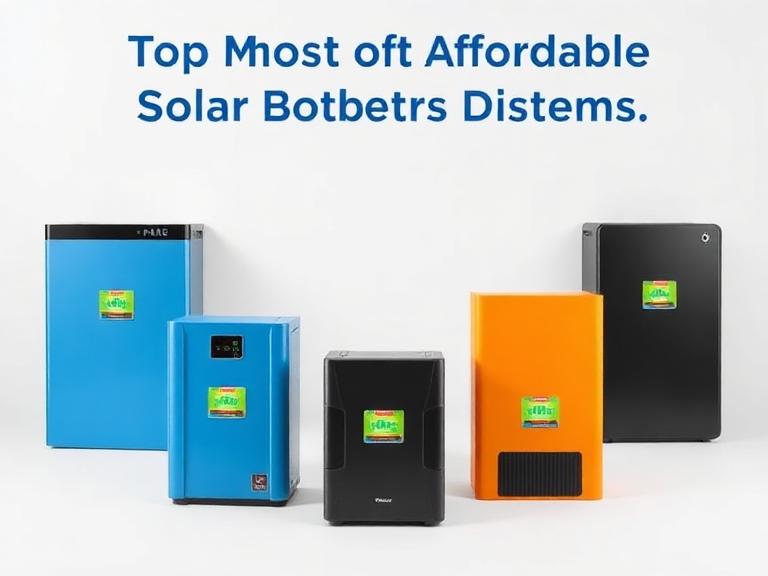
- 3. Top 5 Cheapest Whole House Solar Batteries of 2026
- 4. The Role of BOS Components in Total System Cost
- 5. Future-Proofing: Monitoring and EV Integration
- 6. Summary Comparison Table
- 7. Frequently Asked Questions (FAQs)
- 8. References
1. Defining Value: Upfront Cost vs. LCOS
When discussing the cheapest whole house solar batteries, we must distinguish between different lithium-ion chemistries. By 2026, Lithium Iron Phosphate (LiFePO4 or LFP) has become the dominant chemistry for residential use due to its safety profile and cycle life. From our experience, LFP offers the best value for money because it can typically withstand 6,000 to 10,000 cycles before significant degradation, whereas older Nickel Manganese Cobalt (NMC) chemistries often struggle beyond 3,000 cycles.
We recommend homeowners look for the cost per kilowatt-hour (kWh) of usable capacity. In the current 2026 market, the benchmark for a high-value system is approximately 300 to 450 dollars per kWh at the wholesale level. However, a cheap battery without a sophisticated management system will fail prematurely. To ensure the lowest long-term cost, the focus must remain on the quality of the Lithium Battery Pack itself and its ability to maintain cell balance over thousands of discharge cycles.
2. Technical Pillars: BMS, PCS, and System Efficiency
The total cost of ownership is heavily influenced by two internal components: the Battery Management System (BMS) and the Power Conversion System (PCS). From our heritage in high-reliability systems, we understand that these are the brains and the muscle of the battery, respectively.
The Critical Role of the BMS
A sophisticated Battery Management System (BMS) is the primary factor in preventing thermal runaway and ensuring cell longevity. It monitors voltage, current, and temperature at the cell level. In cheaper batteries, the BMS is often an afterthought, which leads to unbalanced cells and a rapid drop in usable capacity. From an engineering standpoint, the cheapest whole house solar batteries are those with a high-reliability BMS that maximizes every cent of your lithium investment.
The PCS and Conversion Losses
The Power Conversion System (PCS) handles the inversion from DC to AC and vice versa. Cheap systems often suffer from high conversion losses. If your PCS has an efficiency of only 85 percent, you are losing 15 percent of your generated solar energy every time it enters or leaves the battery. High-efficiency PCS components are essential for maintaining the economic viability of the system over a decade of use.
3. Top 5 Cheapest Whole House Solar Batteries of 2026
1. Modular LFP Stack Systems (The Vertical Integration Leader)
Modular systems allow homeowners to start small and expand. In 2026, vertical LFP stacks have become the value leaders. By stacking 5kWh modules, users can customize their capacity precisely. This eliminates the “over-buying” penalty. We recommend these for their ease of installation and high reliability, as the failure of one module does not typically take down the entire system.
2. Server-Rack LiFePO4 Arrays (The DIY and Budget Champion)
Originally designed for data centers, 48V/51.2V server-rack batteries offer the absolute lowest cost per kWh in the 2026 market. While they require a separate hybrid inverter, the raw cost of the Lithium Battery Pack is unrivaled. For those comfortable with more hands-on system design, this is the most direct route to the cheapest whole house solar batteries configuration.
3. High-Density Wall-Mounted Units (The All-in-One Value)
Wall-mounted units designed for sleek, indoor/outdoor installation offer significant savings on labor. These systems often integrate the BMS and PCS into a single enclosure. From our experience, the reduced installation time often makes the total installed cost cheaper than modular components that require complex wiring.
4. Hybrid-Inverter Optimized DC Coupled Systems
By using a DC-coupled architecture, these systems bypass the need for an additional AC-coupled inverter, significantly reducing the cost of BOS Components (Balance of System). The efficiency gains from avoiding an extra DC-to-AC conversion step directly translate into a lower LCOS over the system’s life.
5. Second-Life Tier 1 Industrial Packs
A burgeoning market in 2026 involves using Tier 1 automotive cells that have reached 80 percent capacity and repurposing them for stationary storage. While these have a shorter remaining lifespan, their extremely low upfront cost makes them an attractive entry point for those looking for the cheapest whole house solar batteries for temporary or secondary residences.
4. The Role of BOS Components in Total System Cost
Homeowners often overlook the “soft costs” and auxiliary hardware known as BOS Components. This includes cabling, mounting racks, switchgear, and protective enclosures. From our professional experience, poorly designed BOS can add up to 20 percent to the total project cost. We recommend choosing batteries with simplified connection interfaces to minimize these hidden expenses.
Standardizing the electrical architecture and using high-quality busbars and disconnects not only ensures safety but also simplifies maintenance. In the context of the cheapest whole house solar batteries, a system that is “easy to wire” is a system that is “cheap to install.”
5. Future-Proofing: Monitoring and EV Integration
The cheapest whole house solar batteries are only as good as the software managing them. Advanced Monitoring & Communication systems allow for remote firmware updates and real-time troubleshooting. This prevents minor cell imbalances from becoming permanent failures, effectively extending the battery life and lowering the long-term cost.
Furthermore, in 2026, the energy ecosystem must include transportation. Integrating an AC EV Charger with your solar battery system allows for “Solar-to-EV” charging, bypassing the grid entirely. This synergy maximizes the utilization of your stored energy, significantly improving the ROI of the entire energy storage investment.
6. Summary Comparison Table
| Battery Type | Average Cost per kWh (2026) | Cycle Life (LFP) | Best For |
|---|---|---|---|
| Modular LFP Stack | $350 – $450 | 6,000+ | Scalability and standard homes |
| Server-Rack Units | $280 – $350 | 5,000+ | Lowest upfront hardware cost |
| Wall-Mounted All-in-One | $400 – $500 | 6,000+ | Easy installation and aesthetics |
| DC Coupled Hybrid | $380 – $460 | 7,000+ | Highest conversion efficiency |
| Second-Life Tier 1 | $150 – $250 | 2,000 – 3,000 | Short-term or budget-critical use |
7. Frequently Asked Questions (FAQs)
What is the most important component when looking for the cheapest whole house solar batteries?
From an engineering perspective, the Battery Management System (BMS) is paramount. A cheap battery with a poor BMS will fail in a few years, making it more expensive in the long run than a slightly higher-priced unit with high-reliability electronics.
Are the cheapest whole house solar batteries safe?
Safety depends on the chemistry and the manufacturing standards. We recommend LiFePO4 chemistry as it is much more thermally stable than NMC. Always check for UL1973 or equivalent aerospace-grade testing standards to ensure the system integrity.
Can I install the cheapest whole house solar batteries myself to save money?
While server-rack systems are popular for DIY, we recommend professional installation for anything connected to the main grid. Poor wiring can lead to energy losses and fire hazards, negating any savings from the low hardware cost.
Does temperature affect the cost of these batteries?
Yes. If you live in an extreme climate, a “cheap” battery without proper thermal management will degrade quickly. Investing in a system with better climate control components may have a higher upfront cost but a much lower cost per year of operation.
8. References
- U.S. Department of Energy – Homeowner’s Guide to Solar and Storage
- National Renewable Energy Laboratory (NREL) – Cost Projections for Utility-Scale Battery Storage
- China MoneyPro Energy – Internal Engineering and System Integrity Whitepapers
- International Energy Agency (IEA) – Solar PV and Storage Outlook
In conclusion, identifying the cheapest whole house solar batteries requires a balance of metallurgical knowledge, electrical engineering, and financial foresight. By prioritizing systems with high-reliability BMS and PCS units, and by considering the total ecosystem including AC EV Charger integration, homeowners can achieve true energy independence at the lowest possible lifetime cost. Affordability is an engineering metric, not just a price tag.